
Algeria votes today as turnout anxiety overshadows its tenth parliamentary election
Algerians are choosing 407 members of the People's National Assembly on Thursday in an election shaped by sweeping new electoral laws, mass candidate disqualifications and a ruling establishment acutely aware that a repeat of 2021's record-low 23 percent turnout would carry its own verdict.
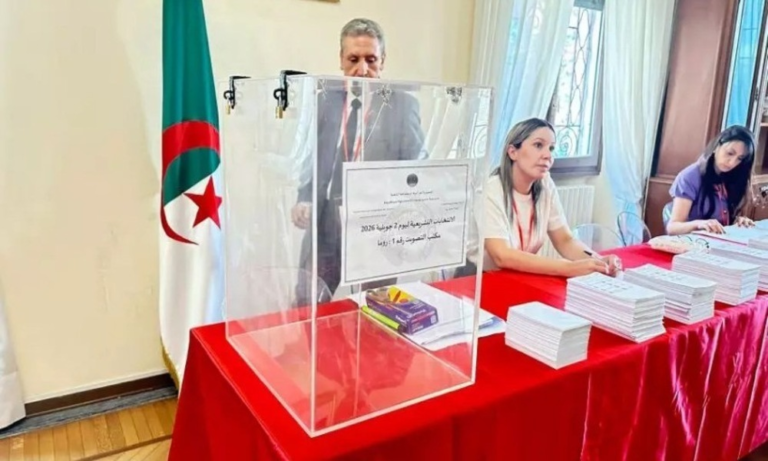
Algeria is voting on Thursday 2 July 2026 to elect 407 members of the People's National Assembly (APN), the country's lower house of parliament, in what is the tenth legislative election since independence. The central question, observers say, is less about which party wins the most seats than about whether enough citizens bother to turn out at all.
Who is voting and how many
More than 24.7 million registered voters, including about 854,000 living abroad, are eligible to vote, according to the Independent National Authority of Elections (ANIE). The electorate is composed of 13,255,949 men and 11,471,091 women.
The 407 seats are distributed across 77 electoral constituencies: 69 covering the country's wilayas and 8 reserved for the Algerian community abroad. For the first time, North America and Latin America form a fully independent electoral constituency — zone 5 — with two dedicated seats in the APN; until now, Algerians on the American continent were grouped with part of Europe within the same zone.
A total of 793 electoral lists are competing for the 407 seats. Of those, 613 are presented by 32 political parties, one list comes from a party alliance, and 125 are independent lists. The total number of candidates stands at 9,854, of whom 2,032 are women, representing 21 percent. Some 5,304 candidates, or 54 percent, are under 40 years of age.
The turnout problem
The outgoing parliament, elected in 2021, recorded a turnout of just 23 percent, the lowest in any legislative election since independence in 1962. Analysts and opposition figures say a repeat of that figure, or worse, would carry a political message in itself.
Researcher Nacer Djabi, a former professor of sociology at the University of Algiers 2, told Middle East Eye that apart from party activists and their families, "the average citizen has long been disinterested in this type of election, a trend that has only intensified since the end of the Hirak protests."
The electoral campaign has also competed for public attention with the Algerian national football team's participation in the 2026 World Cup, which has dominated social media and street conversation.
New rules, mass disqualifications
This is the first legislative contest since President Abdelmadjid Tebboune consolidated his authority following his re-election and a series of constitutional and electoral reforms. Major constitutional reforms were enacted in March 2026, including changes to the executive power structure and how seats in the upper house, the Council of the Nation, are allocated by province.
The most contentious measure is Article 200 of Algeria's electoral law, introduced under amendments adopted in April 2026 to prevent "dirty money" from influencing elections. Critics argue its broad wording grants authorities wide discretion over who can stand. The ANIE invalidated around 300 candidates primarily on the basis of Article 200.
The Islamist Movement of Society for Peace (MSP) described the application of Article 200 as "arbitrary," saying disqualifications were issued "without clear legal evidence or any final court judgment." Louisa Hanoune, secretary-general of the Workers' Party, called it "elastic, overly vague, and open to all readings and interpretations." Among those affected were candidates from established parties including the National Liberation Front (FLN), the National Democratic Rally (RND) and the MSP itself, resulting in the exclusion of numerous incumbent lawmakers.
The independent candidacy channel has also contracted sharply. In 2021, the country saw 1,483 lists accepted after filtering, of which 837 were independent, and that wave of citizen candidates produced a historic 84 independent deputies who became the APN's second-largest force. In 2026, the total number of lists submitted collapsed to 852, with only 144 independent lists validated nationally.
Who stands where
The governing National Liberation Front (FLN) and its pro-government ally, the National Democratic Rally (RND), face competition from the MSP, as well as nationalist, Islamist and independent lists. The FLN — the former single ruling party that emerged from the war of independence against France — controls over a quarter of the outgoing assembly, with 105 of 407 seats. It is followed by the MSP with 64 elected members, and the RND, established in 1997 by government officials to support the ruling elite, which holds 57 seats.
The Socialist Forces Front (FFS), which boycotted the 2021 vote, has returned to the contest, fielding 30 candidate lists in an attempt to regain parliamentary representation. Parties dominant in the immediate post-2019 period, including the RND and El Bina, appear to be losing favour , according to Nouri Dris, a sociology professor at the University of Sétif, speaking to Al Jazeera.
What the vote can and cannot change
President Tebboune has framed the vote as part of the building of a "new Algeria" after the 2019 uprising, but critics argue executive power remains dominant, with parliament playing a limited legislative role and opposition activity constrained by legal and political pressure.
Human rights groups, including Amnesty International and Human Rights Watch, have raised concerns over restrictions on opposition activity, independent media and civil society. Tebboune has rejected such criticism, arguing reforms have strengthened institutions and preserved stability.
Nacer Djabi told Middle East Eye that the legislative body is "controlled by the authorities and is completely subservient to the executive branch." He said the political landscape "will therefore not be reshaped, but it will allow the ruling parties, the RND and the FLN, to maintain their advantages."
Results are expected from the ANIE later on Thursday or on Friday 3 July. This is a developing story.