
Ali Khamenei lies in state in Tehran as Iran opens a week of funeral ceremonies
The body of Iran's former Supreme Leader Ayatollah Ali Khamenei was laid in state at Tehran's Grand Mosalla on Friday, drawing dignitaries from more than 100 countries to the first stage of a seven-day procession that authorities say could attract up to 20 million mourners before burial in Mashhad o
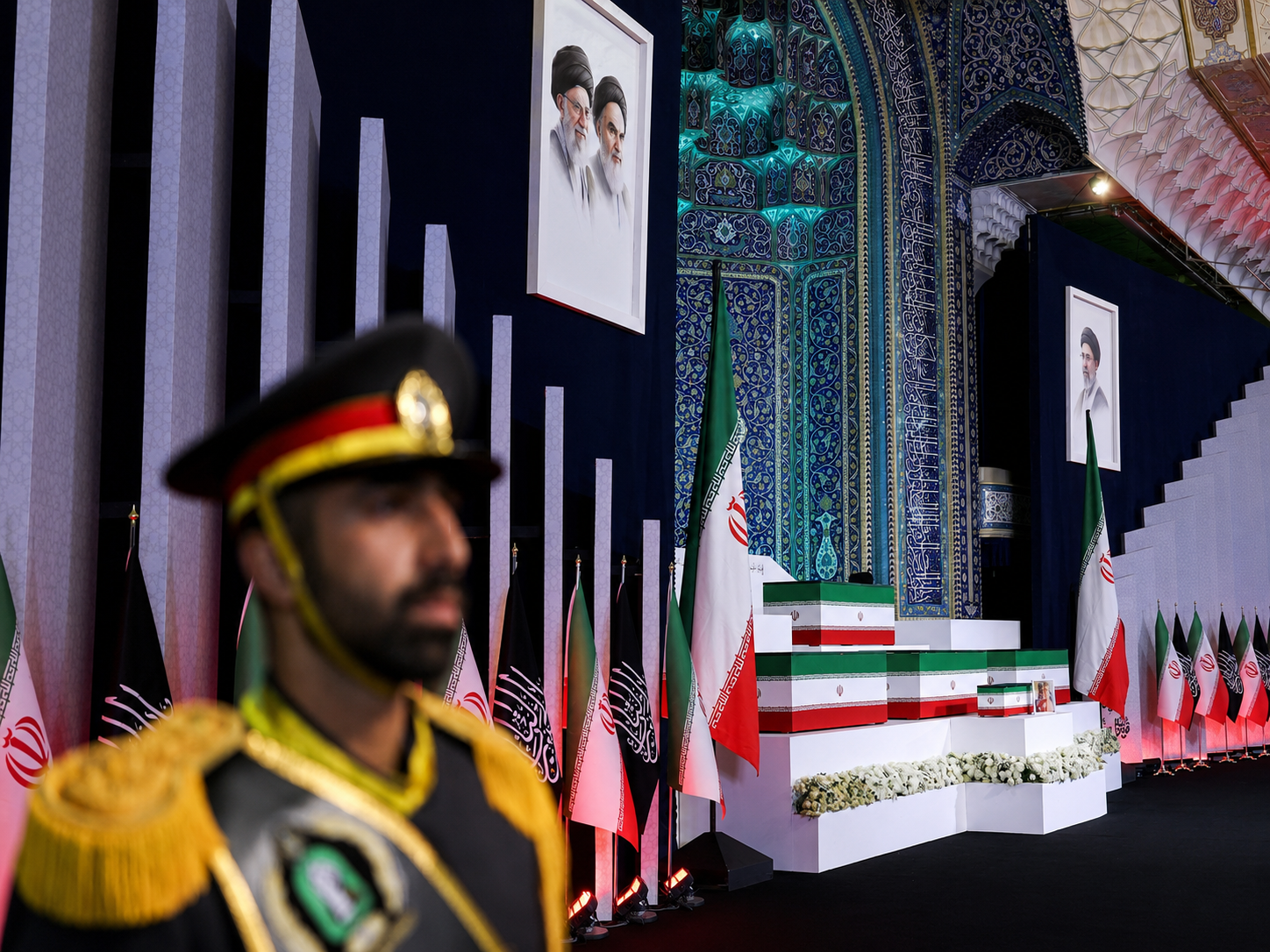
The body of Ayatollah Ali Khamenei lay in state at Tehran's vast Grand Mosalla on Friday 3 July as clerics, government officials and foreign dignitaries from more than 100 countries filed past his coffin, opening a week of ceremonies that Iran is billing as the largest state funeral in its history.
Khamenei, who was killed in the opening US-Israeli airstrikes of the war against Iran on 28 February, was 86 years old. Iran is staging a week of mass funeral processions for the leader, whose 37-year reign was brought to an end by the first airstrike of the war, in a show of public devotion to the Islamic Republic's theocratic state and revolutionary zeal.
His coffin was unveiled late on Thursday to a throng of sobbing supporters. On Friday, the coffin — and those of family members killed alongside him — was laid in state in Tehran's Grand Mosalla, the great prayer hall built to honour his predecessor, Ayatollah Ruhollah Khomeini. Killed alongside Khamenei, and displayed in coffins next to his, were his daughter, son-in-law and baby granddaughter, as well as the wife of his son Mojtaba.
A week of processions across two countries
Public viewing is scheduled to begin on Saturday morning, with authorities preparing to manage crowds amid a regional heatwave. Khamenei's body will be on display at Tehran's Grand Mosalla on Saturday and Sunday. On Monday it will be paraded through the streets of Tehran before being taken to the Shia seminary city of Qom, around 120 kilometres to the south. Tuesday will see Khamenei honoured there.
Ceremonies will then be held in Iraq's shrine cities of Najaf and Karbala on Wednesday, with prominent attendees from Iran's regional network of Shia proxies. He will be buried on Thursday, after another procession, in Mashhad near the tomb of the Imam Reza, a figure of great devotion in Iran. Mashhad is also where Khamenei was born.
The burial had originally been scheduled for March, but the months-long conflict delayed the funeral rites until this week. The ceremonies are expected to draw between 15 and 20 million mourners, according to officials, which would make it the biggest state funeral in the country's history.
Dignitaries converge; Western nations absent
Foreign officials attending included Pakistani Prime Minister Shehbaz Sharif, Iraqi President Nizar Amidi and Tajik President Emomali Rahmon. Turkey sent Vice President Cevdet Yılmaz. Azerbaijan's delegation was led by parliamentary speaker Sahiba Gafarova, with some reports suggesting President Ilham Aliyev might also attend. Armenian Prime Minister Nikol Pashinyan and Georgian President Mikheil Kavelashvili were also due to attend.
Iranian President Masoud Pezeshkian paid his respects to Khamenei on Friday, state media reported. Iran's own political leaders — the president, parliament speaker, foreign minister and others — filed in to weep and pray on Friday morning. A group of generals stood saluting in front of the coffin. Western nations sent no senior representatives.
Islamic Revolutionary Guard Corps (IRGC) top commander Ahmad Vahidi appeared in public on Thursday for the first time since the war began in February, paying his respects beside Khamenei's coffin. He had not been seen publicly since 8 February, weeks before the war started.
Questions over Iran's new leader
Following the assassination of Ali Khamenei on 28 February, Iran's Assembly of Experts held an election for a new supreme leader from 3 to 8 March 2026. Mojtaba Khamenei, son of Ali Khamenei, was announced as the new supreme leader on 9 March.
Mojtaba Khamenei, 56, who was named successor to his father in March, has not been seen in public or issued an audio statement since the war began. He was severely injured in the strike that killed his father, according to three people with knowledge of the matter, with burns to his face and body and wounds that required several operations to one of his legs. The full extent of his injuries — and how they are affecting his ability to fulfil his duties — remains unknown.
Iran's current supreme leader will not be attending the funeral, his representative to India said on Thursday. This is due to security reasons following Israel's latest threat to assassinate Mojtaba Khamenei. Iranian officials said he is recovering from his injuries and continues to direct Tehran's negotiations with Washington solely through written statements.
Security lockdown and war warnings
Tehran streets were tightly controlled, with military and police vehicles lining the major roads and police and members of the black-shirted volunteer Basij paramilitary force patrolling on motorbikes. Tehran's airspace will be completely closed on Monday for the funeral procession. "On Monday, coinciding with the funeral procession for the late revolutionary leader, Tehran's airspace will be completely closed, and no flights will be permitted," Iran's Civil Aviation Organisation said.
The IRGC warned on Friday against any attempts to target the country in the coming days, stating that "any miscalculation will be met with a decisive and more crushing response than ever before." This came after Israeli Defence Minister Israel Katz said that Iran's Supreme Leader Mojtaba Khamenei was "marked for death," in comments reported by the Israeli news agency Ynet.
Tehran, Qom and Mashhad will be closed during the relevant ceremonies, officials said, and all public and private offices in Tehran have been ordered shut from Saturday to Monday, with much of the city centre closed to private vehicles.
Peace talks on hold
Officials from both countries agreed to pause formal negotiations until after the funeral ceremonies. The talks, held separately between US and Iranian delegations with Qatari and Pakistani mediators, were the latest attempt to build on the June ceasefire that halted months of fighting between Washington, Israel and Tehran.
Qatar and Pakistan said in a joint statement that "positive progress was made" during indirect talks in Doha on issues related to the Islamabad Memorandum of Understanding. "The parties agreed to continue discussions over the coming period, with the next meeting to be scheduled at the earliest possible time following the funeral processions," the two mediators said.
The interim deal reached in June created a 60-day window to negotiate the terms of a final agreement, including the issues of Iran's nuclear programme and the Strait of Hormuz. Officials familiar with the negotiations said no additional formal meetings are expected until after Khamenei's funeral concludes on 9 July, when mediators hope both sides will return to Doha to tackle the remaining disputes over maritime security, sanctions relief, regional stability and the framework for future nuclear negotiations.
The next stage of public ceremonies begins in Tehran on Saturday 4 July.