
China's SpaceSail accelerates African push as constellation reaches 200 satellites
Shanghai Spacecom Satellite Technology is deepening its drive into African markets, registering trademarks in South Africa and courting governments across the continent as it races to build a low-Earth orbit network it hopes will challenge Starlink's dominance in underserved regions.
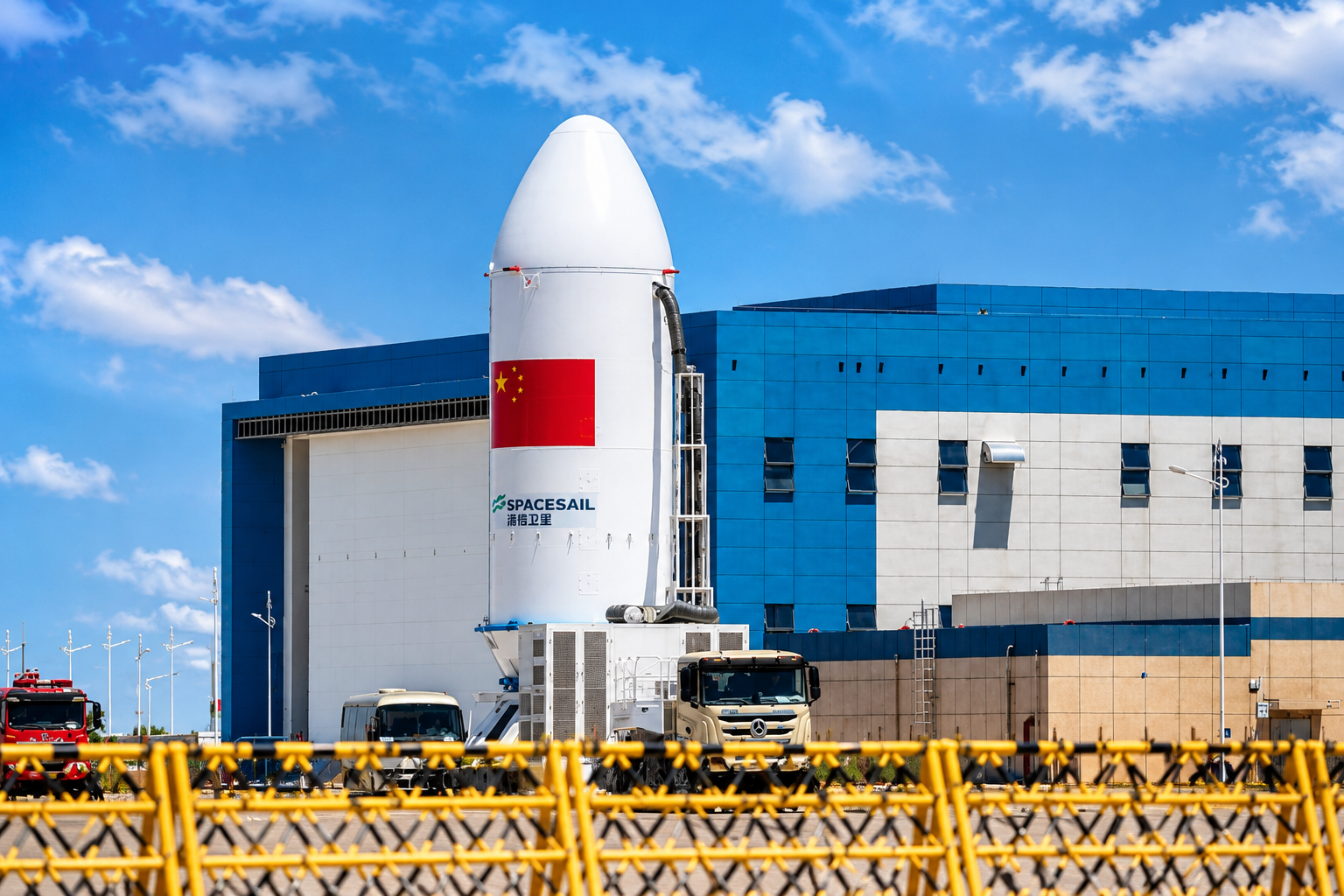
China's low-Earth orbit satellite operator SpaceSail is pushing deeper into African markets, registering trademarks in South Africa, courting governments across the continent and reaching a fleet of 200 satellites in orbit on 5 June 2026 — a milestone the company says gives it enough capacity to launch its first commercial service.
SpaceSail, officially known as the Qianfan or "Thousand Sails" constellation, is built and operated by Shanghai Spacecom Satellite Technology (SSST), a firm backed by the Shanghai Municipal People's Government and the Chinese Academy of Sciences. The project, started in 2024, is designed as a rival to SpaceX's Starlink constellation and aims to place over 15,000 satellites in orbit.
200 satellites and a first commercial application
SpaceSail launched three batches of satellites in five days, reaching 200 in orbit on 5 June. With 200 satellites now in orbit, the company said it has enough capacity to support its first commercial application — tracking maritime vessels at sea — and aims to begin broader commercial services by the end of 2026.
On 1 June, SpaceSail launched two satellites on a new Chinese reusable rocket, the Long March-12B, similar in concept to the technology that allowed SpaceX to build Starlink affordably. Developed by a commercial rocket manufacturing company under the China Aerospace Science and Technology Corporation (CASC), the Long March-12B is a new-generation reusable rocket, though no first-stage recovery test was conducted on this mission; one is scheduled for a later date.
To retain their full spectrum rights with the International Telecommunication Union (ITU), SpaceSail and a parallel Chinese constellation, Guowang, must each have at least ten percent of their planned networks in orbit by the end of 2026. SpaceSail's 200 satellites represent around 1.3 percent of its 15,000-satellite ultimate goal, leaving significant ground to cover before that ITU threshold.
Africa: governments are receptive, deals remain limited
Governments across Africa have welcomed the prospect of a new entrant, according to Temidayo Oniosun, chief executive of Space in Africa, a Lagos-based firm tracking the continent's satellite industry. "After gaining market share, Starlink has done several price increases because the competition isn't there," Oniosun told Rest of World. "People in those cities may be looking for alternatives."
Starlink's dominance has created friction in Africa, where users in several cities have had no alternative provider as service quality declined. SpaceSail registered trademarks in South Africa last year. Starlink is currently available in only 19 African countries, having faced licensing and regulatory challenges across much of the continent.
In March 2026, the Communications Regulatory Authority of Namibia formally rejected Starlink's licence and spectrum applications, citing non-compliance with local ownership regulations requiring at least 51 percent Namibian citizen ownership. Analysts say such decisions open space for SpaceSail, whose state-backed model allows it to work through government-level agreements rather than direct consumer sales.
Even where SpaceSail gains a foothold, replacing Starlink will take time, Oniosun said. Users who have invested in Starlink hardware may be reluctant to pay again, though in cities where Starlink's quality has dropped due to overloaded capacity, users may be more open to a new provider.
A strategy built on state ties and Belt and Road alignment
SpaceSail has signalled negotiations with roughly 30 countries and has so far announced early commercial arrangements in at least four of them: Brazil, Malaysia, Thailand and Kazakhstan. No binding commercial deal specifically covering an African country has been publicly confirmed in available sourcing.
African states, many of which already benefit from investment under China's Belt and Road Initiative, may find SpaceSail's integration with existing Chinese-owned infrastructure easier than alternatives. Unlike Starlink, which targets mass-market consumers, SpaceSail is positioning itself as a state-backed space backbone, focused on telecom operators, government clients and enterprise users in countries aligned with or courted by China's Belt and Road initiative.
SpaceSail's playbook of state backing, non-Western markets and government-level deals resembles that of BYD, the Chinese electric car maker that grew with billions in subsidies and overtook Tesla in global sales, according to Blaine Curcio, founder of Orbital Gateway Consulting.
Some countries, Curcio noted, will need assurance that their traffic is not routed to the US government, while others will need assurances that traffic is not going to the Chinese government or that sites are not being blocked. Digital sovereignty concerns cut in both directions.
Deployment pace and the reusability gap
SpaceSail secured about $943 million in government-led Series A funding in early 2024 to advance the constellation. China Central Television reported that the company had planned to deploy 648 satellites by the end of 2025 , a target that multiple analysts, including the European think tank Merics, say was not met.
The growing dependence of countries on Chinese space infrastructure should concern US policymakers, said Ellis Scherer, a space policy analyst at the Information Technology and Innovation Foundation, a Washington-based think tank tracking Chinese space capabilities. "China still lacks a mission-ready, fully reusable rocket like SpaceX's Falcon 9," Scherer told Rest of World. The Long March-12B maiden flight on 1 June represents China's most direct effort yet to close that gap, though its reusability remains undemonstrated in practice.
Panasonic Avionics has signed a memorandum of understanding with SpaceSail and plans to offer a multi-network low-Earth orbit inflight connectivity service combining SpaceSail and Eutelsat OneWeb by 2027, covering both G7 and BRICS countries.
For Tunisia and the wider Maghreb, SpaceSail's Africa push carries practical relevance. Satellite broadband has long been constrained in the region by the limited presence of competitive operators; a new entrant targeting government and enterprise clients could widen options for connectivity in underserved rural areas, though no specific North Africa announcement has emerged from either the company or regional governments.