
EU institutions channelled billions to Israel during Gaza war, investigation finds
A new investigation by Al Jazeera published on Thursday documents the scale of financial flows from EU institutions to Israel since October 2023, spanning research grants, trade, investment and services — even as the bloc's own review found indications that Israel had breached the human rights claus
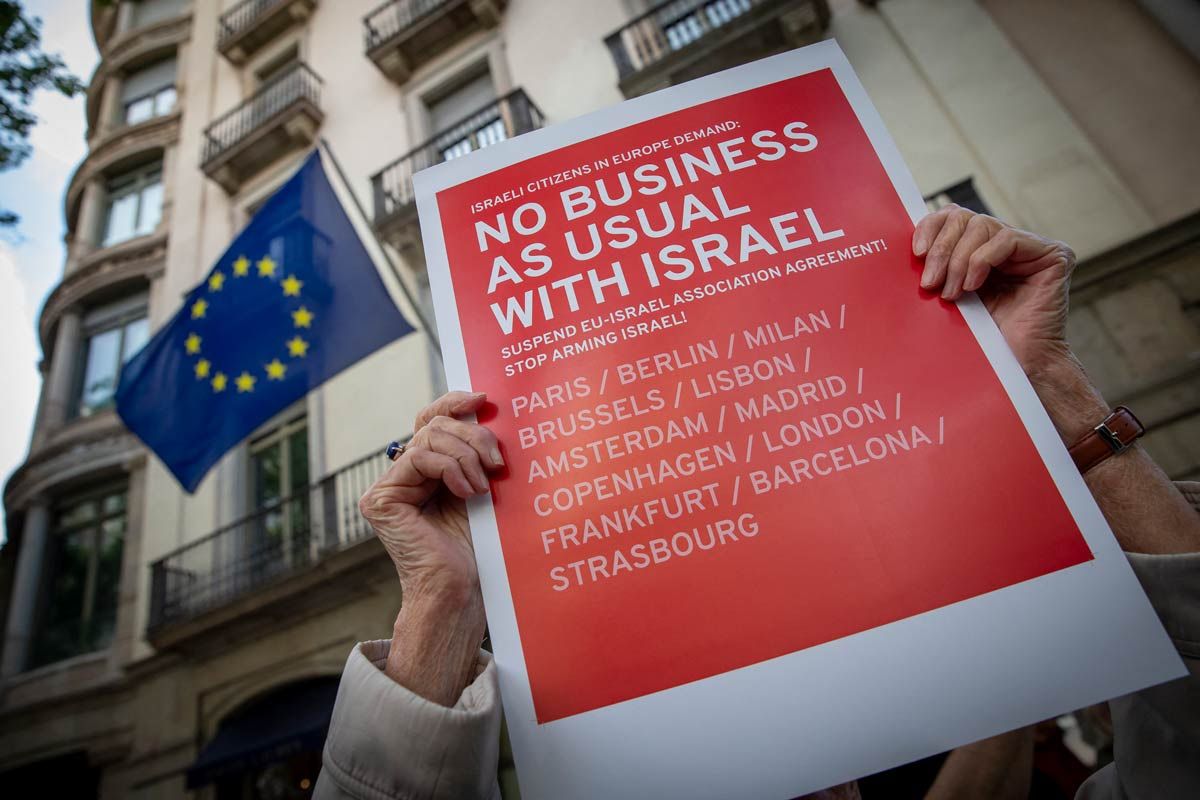
EU institutions channelled billions of euros to Israel during the Gaza war through research grants, preferential trade arrangements and investment programmes, even as the bloc's own review found that Israel had breached the human rights clause of its central agreement with the European Union, an investigation published on Thursday by Al Jazeera has found.
The investigation documents the cumulative scale of financial flows from EU bodies to Israel since October 2023 and raises fresh questions about the coherence of European foreign policy at a moment when the bloc has publicly acknowledged Israel's violations of international law.
The scale of EU-Israel financial ties
Total trade in goods between the EU and Israel amounted to €43.3 billion in 2025 , making the EU Israel's single largest trading partner. Two-way trade in services between the EU and Israel amounted to a further €26.6 billion in 2024.
The EU is the largest investor in Israel worldwide, nearly twice as large as the United States. EU member states held €72.1 billion in foreign investment in Israel in 2023, compared with €39.2 billion for the US, according to the most recent IMF data. Of all EU member states, the Netherlands is by far the largest investor in Israel, responsible for two-thirds of EU investment in the country.
Targeting Israel through its trade agreements could be a powerful lever, analysts have said, because the economic leverage the EU holds over Israel is unparalleled — the bloc is Israel's biggest trading partner, far surpassing the United States in bilateral goods exchanges.
Research grants: Horizon and the defence industry link
Under the Horizon 2020 framework programme that ran between 2014 and 2020, Israeli organisations received a total EU contribution of €1.28 billion. Since Horizon Europe was launched in 2021, Israeli institutions have been granted over €747 million.
Data collected by the European Commission and analysed by Al Jazeera shows that since October 2023, the EU awarded Israeli institutions more than €238 million, including €640,000 to Israel Aerospace Industries (IAI), a major aerospace and aviation manufacturer supplying the Israeli army.
IAI received a total of €2.7 million under Horizon Europe and over €10.7 million under Horizon 2020, European Commission data shows. Elbit Systems, whose biggest single customer is the Israeli Ministry of Defence, was awarded grants for five projects under Horizon 2020 for a total of €2.2 million.
Rafael Advanced Defense Systems, a major Israeli defence company, is set to receive almost €450,000 from a Horizon project, alongside the Israeli Ministry of Defence, which receives €100,000.
Horizon guidelines require funded projects to be "exclusively focused on civil applications" but acknowledge that a "considerable number of technologies and products are generic and can address the needs of both civil and military users." Technology that can serve both civil and military uses — so-called dual use — may qualify for EU funding as long as the stated objective is civil.
Al Jazeera filed a freedom of information request seeking the results of ethics assessments of projects involving Israel. The European Commission denied the request, saying their disclosure would "seriously undermine the Commission's functioning and internal decision-making process".
The Association Agreement: review without suspension
By spring 2026, the European Union had not suspended the EU–Israel Association Agreement, despite an official review concluding that there were "indications" Israel had breached Article 2, which makes respect for human rights and democratic principles an essential element of the agreement.
On 20 May 2025, High Representative Kaja Kallas announced the launch of an Article 2 review; the findings, presented to the Foreign Affairs Council on 23 June 2025, concluded there were indications that Israel was in breach of its human rights obligations.
At a meeting of EU foreign ministers held within the framework of the Foreign Affairs Council in Luxembourg in April 2026, no consensus was reached to suspend the pact, despite a coordinated effort led by Spain, Ireland and Slovenia. The proposal failed due to opposition from Germany and Italy, which argued against punitive measures and in favour of maintaining diplomatic engagement.
After the meeting, EU High Representative Kaja Kallas said there was "no unanimity on the proposal tabled by some member states for a full or partial suspension of the EU-Israel Association Agreement."
The core reason for inaction was not the absence of legal or political grounds, but the lack of a sufficient majority in the Council — and in particular the absence of unanimity required for full suspension.
According to EU data, trade in goods between the bloc and Israel amounted to €42.6 billion in 2024. A partial suspension of the EU-Israel agreement could directly impact about €5.8 billion worth of Israeli exports.
Calls for suspension and the legal argument
UN experts said the EU must immediately suspend the EU–Israel Association Agreement, which has granted Israel preferential access to the European market since 2000, despite what they described as well-documented human rights violations that have escalated into atrocity crimes including genocide.
A European Citizens' Initiative calling for full suspension of the agreement has gathered over one million signatures. Twenty UN experts called for immediate suspension, stating that "the EU cannot credibly claim to uphold human rights while sustaining preferential trade with a State whose conduct has been found by multiple international bodies as amounting to genocide, crimes against humanity, and war crimes."
A European Commission proposal to deny Israel partial access to the €95 billion Horizon Europe research fund failed to garner the necessary qualified majority support when EU ambassadors met in Brussels in July 2025 to discuss the issue. Germany and Italy said they needed more time to examine it.
A full suspension of the Association Agreement would require a unanimous decision from all 27 member states, which analysts say is currently impossible. Suspending only the commercial arrangements requires a qualified majority of at least 15 EU countries representing 65 percent of the EU population — a threshold that gives heavily populated nations such as Germany what amounts to a veto.
Military goods and wider arms flows
A separate Al Jazeera investigation found that military-related goods from at least 51 countries entered Israel throughout the Gaza war, despite the International Court of Justice's January 2024 ruling that there was a "plausible risk of genocide." Using Israeli Tax Authority import data, customs records and freedom of information requests, the team examined more than 2,600 consignments of military-related goods entering Israel between October 2023 and October 2025, valued at around 3.22 billion shekels (approximately $885 million).
Ninety-one percent of that total was recorded after the ICJ ruling. The United States remained Israel's largest supplier, accounting for more than 42 percent of the total value of imports identified.
The investigation also highlighted shipments from countries that had publicly criticised Israel's actions or announced restrictions on arms exports. Spain, Canada, France, Italy, Germany and the United Kingdom all continued to see military-related goods originating from their territories enter Israel after announcing suspensions or tighter controls.
The Israeli military campaign has resulted in the deaths of more than 72,000 people in the Gaza Strip, mostly civilians, according to the Hamas-run Gaza health ministry, whose figures the UN considers reliable.
Israel has not responded publicly to the specific findings of Thursday's Al Jazeera investigation. Israel and the European Commission both maintain that EU-funded research programmes are governed by rules requiring civilian applications and prohibiting the funding of weapons development.
EU foreign ministers are expected to return to the question of the Association Agreement at upcoming Council sessions, with the bloc's internal divisions over Israel showing no sign of resolution.