
France awaits Le Pen appeal ruling as presidential race hangs in the balance
A Paris appeals court will deliver its verdict on Tuesday in Marine Le Pen's embezzlement case, a ruling that will determine whether the National Rally leader can contest the 2027 presidential election and reshape France's political landscape ahead of the vote.
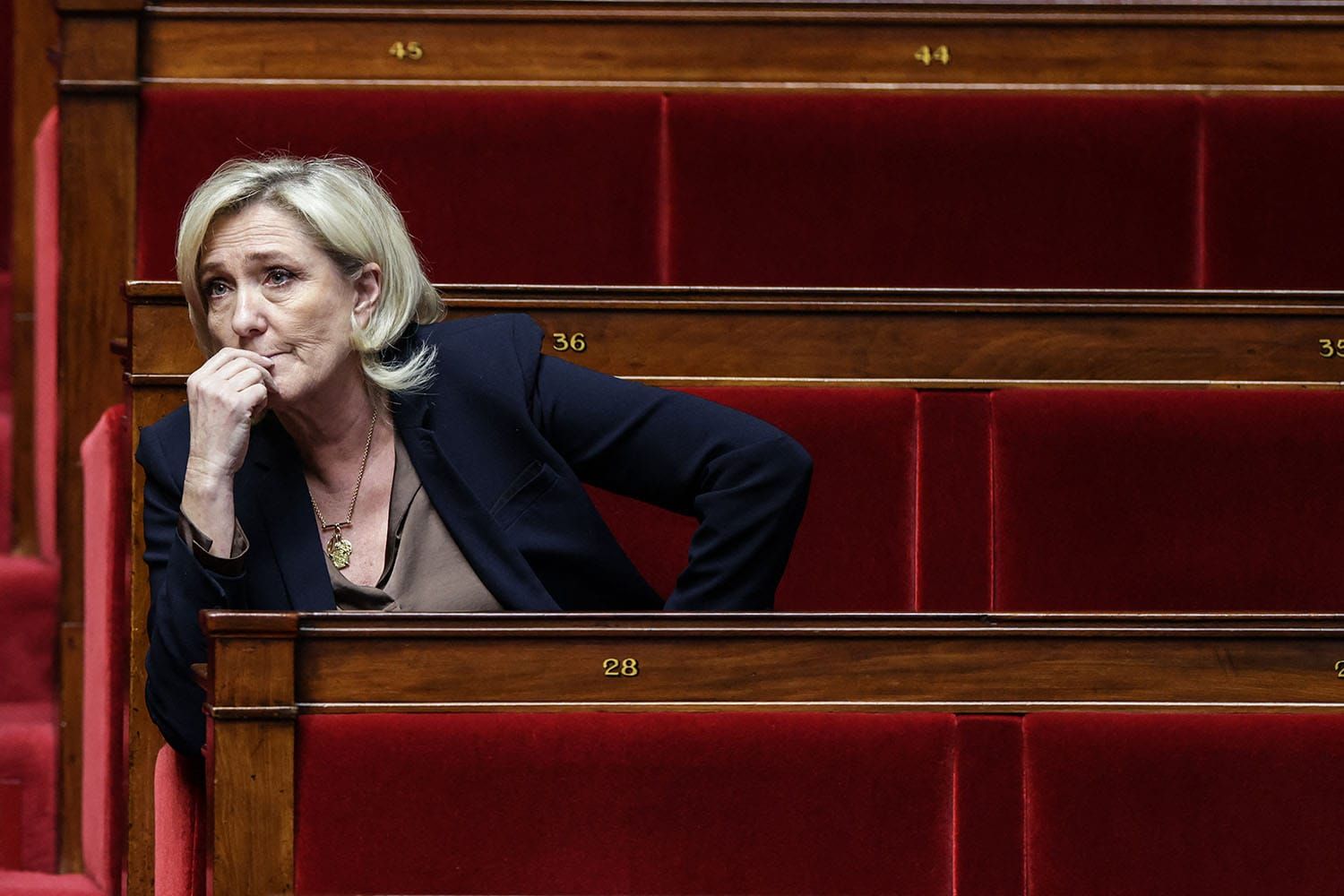
Paris appeals court will rule on Tuesday on whether Marine Le Pen can stand in the 2027 French presidential election, in a verdict that could redraw the starting line of the race to succeed Emmanuel Macron.
Le Pen will find out at 13:30 Paris time (11:30 GMT) whether the court will uphold her embezzlement conviction. The 57-year-old leader of National Rally has already run for president three times and came second to Emmanuel Macron in both 2022 and 2017. With under ten months to go before the vote, she leads in the polls.
What Le Pen was convicted of
Twenty-seven members of the National Front — renamed National Rally in 2018 — were accused of having hired people as European Parliament assistants between 2004 and 2016 to work for the political party while being paid with public funds. The core accusation was that these funds, intended for legitimate parliamentary work, were systematically diverted to finance the party's domestic political activities.
The trial took place in 2024 and the judgement was delivered on 31 March 2025. Marine Le Pen and eight other MEPs were convicted of embezzling public funds. Twelve parliamentary assistants were found guilty of receiving stolen funds. The damages in the case were estimated at €2.9 million.
Le Pen received a sentence of four years in prison, two of which were to be served under electronic tagging. She was also fined €100,000 and given five years of disqualification from public office with provisional execution — meaning immediate enforcement without waiting for appeal — a sentence that prevents her from running for office until 2030, including in the 2027 presidential election.
What happened at appeal
The appeal trial took place from 13 January to 12 February 2026 at the Paris Court of Appeal. In total, eleven defendants, along with the National Rally party as a legal entity, appealed their convictions.
During the appeal trial, Le Pen acknowledged that some employees paid as EU parliamentary aides performed work for her party but insisted that she believed such work was allowed and never attempted to hide it. She argued there was no intent to commit an offence and accused the European Parliament of failing to raise concerns at the time.
Prosecutors demanded the court maintain a five-year ban and a four-year prison term with three years suspended for Le Pen. They asked the court to ban Le Pen from holding elected office for five years and to sentence her to one year under house arrest with an electronic tag.
Le Pen told French channel TF1-LCI on 3 February: "If the prosecution's demands are upheld, I will be prevented from running."
What the ruling could mean
An acquittal would leave Le Pen clear to run for the presidency with her reputation intact. This outcome is seen as unlikely.
If the court finds her guilty and bars her from office for more than two years counting from 31 March 2025, she will not be able to stand. The clock has continued ticking since the five-year ban was handed down. A different outcome would apply if the court imposed a ban of two years or less, which would leave her free to run.
Although prosecutors did not ask for it, the appeals court is free to order the ban on holding elected office to take immediate effect, as the lower court did. Le Pen could still appeal to the Court of Cassation, but it is unclear whether that court would suspend the sentence pending a final ruling. The Court of Cassation has previously said that, if asked to review the case, it would seek to issue a ruling before the 2027 presidential election.
Le Pen has argued that prolonged uncertainty — including a possible appeal to the Court of Cassation — would effectively prevent her from running because she would not want to jeopardise her party's chances. France's presidential race is expected to begin taking shape in September before accelerating early next year. Candidates must also secure the endorsements of 500 elected officials to qualify for the ballot, making it difficult to replace a presidential nominee late in the campaign.
The Bardella factor
If Le Pen is barred from running, her longtime protégé Jordan Bardella, 30, could instead become the party's presidential candidate, reshaping the race to succeed President Emmanuel Macron. Macron cannot run again next year after hitting the limit of two consecutive terms in office.
Multiple polls already suggest Bardella may be more popular than Le Pen and capable of winning a presidential election in his own right. France 24 reported that Bardella "didn't wait for the July 7 verdict and is already positioning himself as the RN's candidate for 2027."
Should the court bar Le Pen from running, RN leaders are expected to denounce a "republic of judges" and call for "political justice", much as they did after the initial trial.
The Paris appeals court set 7 July as the date for its ruling following the close of the five-week appeal hearing. The first round of the French presidential election is on 18 April 2027, and the run-off is on 2 May. The outcome on Tuesday will determine whether Le Pen or Bardella leads the far right into that contest.
This is a developing story. Times of Tunis will update following Tuesday's ruling.