
France records around 1,000 excess deaths as Europe's worst heatwave on record moves east
Public Health France said on Sunday that roughly 1,000 more people died than expected between Wednesday 24 June and Saturday, with 85 percent of victims aged 65 or older, as the WHO put the continent-wide toll above 1,300 and the heat dome shifted towards central and eastern Europe.
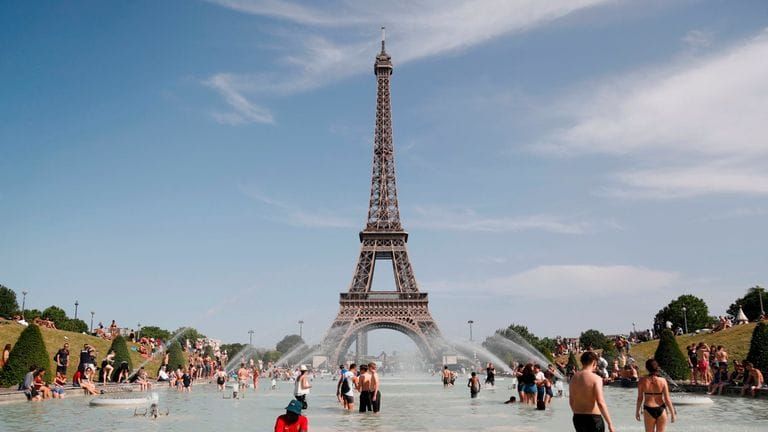
France recorded around 1,000 excess deaths between Wednesday 24 June and Saturday 28 June, Public Health France announced on Sunday, as the country's worst heatwave since records began continued to push temperatures well above 40C and the World Health Organization put the continent-wide toll above 1,300.
The French public health agency said the figure was based on unconsolidated data drawn from digital death certificates, which typically cover around 60 percent of fatalities nationwide. Most of the heat-related fatalities involved older people, the agency warned, adding that the number was expected to rise as more information became available about deaths in residential care and private homes.
Daily deaths climbed above 1,400 on Thursday and Friday, compared with a baseline of around 900 to 1,000 per day during April and May, Santé Publique France said in a statement on Sunday. Of the deaths recorded since Wednesday, 85 percent were people aged 65 or older.
The most-affected areas include those under a red heat alert, particularly Île-de-France, Nouvelle-Aquitaine, Brittany and Centre-Val de Loire.
Record temperatures
Météo-France said France hit its hottest day since measurements began, with Paris recording a June high of 40.9C on Wednesday. A high of 44.3C was measured in parts of Landes, in the south-west.
From 22 June, overnight temperatures were the hottest since records began in 1947, and Météo-France issued a heatwave red alert for 54 departments. The 2026 event activated France's Plan Canicule emergency heat response at the highest scale in its history, with 58 departments under red alert — the largest red-alert footprint the system has ever operated.
Storms that battered parts of France late on Saturday brought some cooler air but caused power outages for thousands of households; as of early Sunday, 63,000 households in northern and central France were without power, electricity provider Enedis said.
Health system under strain
French health minister Stéphanie Rist said in an interview with La Tribune Dimanche that extreme heat has a lagged effect, notably for people with chronic diseases, and that pressure on health services was expected to last beyond any drop in temperatures.
The government recently earmarked €100 million in emergency spending to buy air conditioners, fans and other equipment for hospitals.
Rist said the impact of the heatwave could linger for as long as 10 days after the weather had ebbed. "The episode is not finished," she told broadcaster BFM.
Europe-wide toll
The World Health Organisation said on Sunday that over 1,300 excess deaths had been recorded in Europe since 21 June in connection with the record-breaking heatwave. WHO Director-General Tedros Adhanom Ghebreyesus announced the figures in a post on social media, stressing that "European homes, workplaces and schools were not built for these temperatures".
Tedros said the phenomenon of the "once-in-a-generation" heatwave was "now occurring nearly annual," pointing out that "Europe is the fastest-warming continent on Earth, heating at twice the global average".
Spain and Germany also saw temperatures top 40C. According to Spain's Daily Mortality Monitoring System, more than 400 deaths may have been linked to temperature between Wednesday and Saturday. The United Kingdom recorded its hottest June day on record on Friday; the Met Office said provisional figures showed the village of Santon Downham in Suffolk hit 37.3C.
Poland, the Czech Republic and Slovakia were bracing for record temperatures above 40C on Sunday as the heatwave spread east, with more than 191 million people in Europe forecast to endure temperatures of at least 35C.
Climate context
Scientists have said the heatwave, which began on 20 June, was the worst recorded in Europe, with blistering conditions disrupting power generation, damaging infrastructure and overwhelming healthcare systems.
Meteorologists said the extreme temperatures are driven by a heat dome, a vast area of high pressure parked over western Europe, sustained by a weather pattern known as an omega block — named for the shape it creates in the atmosphere.
Across France, Germany, Italy, Spain and southern England, temperatures have reached 5–12C above seasonal averages, driven by the persistent high-pressure system, which has transported hot air from North Africa into the region while clear skies and strong sunshine have further intensified the heat.
Scientists said the heatwave would have been virtually impossible without man-made climate change, which has made this week's night-time temperatures 100 times more likely than they would have been even two decades ago.
Public Health France said it would issue updated mortality figures as more data from care homes and private residences is collected.