
Western free speech and the Palestine exception
A US federal court has confirmed what every Palestinian in the West already knew: the freedoms their adopted countries boast about were never written for them.
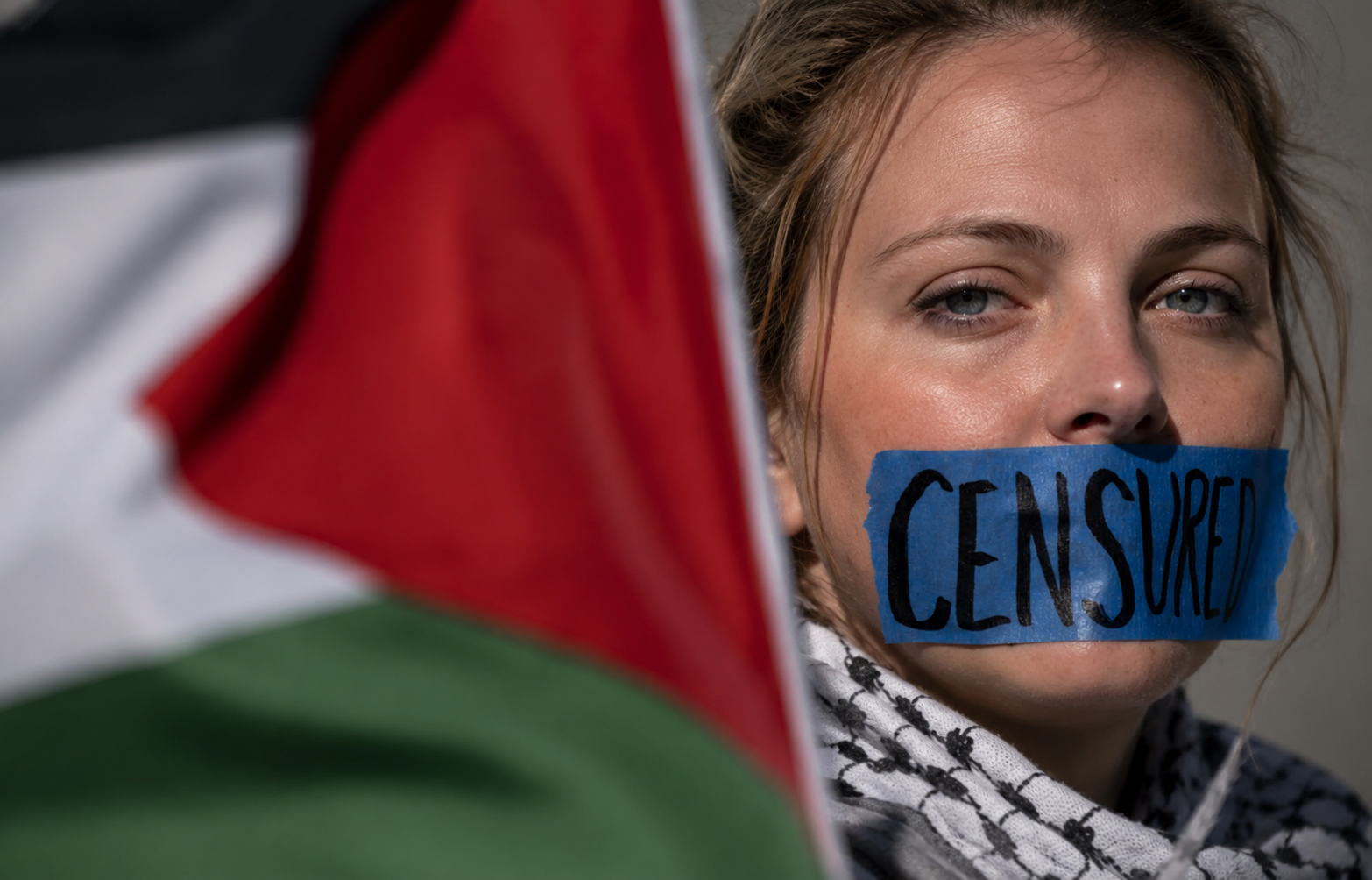
In January a federal judge in the United States said out loud what every Palestinian living in the West already knew. The judge ruled unlawful the policy under which foreign students had been arrested for supporting Palestine. The government's own unsealed files did the rest. Officials had flagged the students for their protests and their writing, and admitted, in their own paperwork, that there were no other grounds to remove them. Not violence. Not fraud. Not a crime of any description. Words.
Sit with that for a moment. The state that lectures the planet on the First Amendment, that has built an entire foreign policy vocabulary around the jailed dissident and the silenced journalist, was caught running a deportation programme against students for the contents of their essays.
This is the Palestine exception, and it is no longer a slogan of the campus left. It is a finding of fact.
The disappeared
Consider who paid, and what they paid with. Mahmoud Khalil, a Columbia graduate who committed the offence of negotiating on behalf of his fellow students, spent more than three months in a detention cell in 2025 and is still fighting deportation, even after federal courts found he had likely been targeted for protected speech. Rümeysa Öztürk, a Turkish doctoral student at Tufts, was grabbed off the street by masked agents. Her crime was an op ed. She sat in a Louisiana facility for weeks before a judge conceded there was nothing against her. Mohsen Mahdawi went to his own citizenship interview and was arrested at it. In June he was ordered deported to Jordan, a country he is from in the eyes of no one but the US government, and he remains in America only because a parallel court case shields him.
Masked men, midnight transfers to the Deep South, prisoners of conscience held for their writing. Change the passports and this is the stuff of a State Department human rights report. When Washington does it, it is called immigration enforcement.
The graduates
The universities, those self-declared cathedrals of free enquiry, have behaved no better. George Washington University banned Cecilia Culver from its own campus for a commencement speech that criticised the university's investments. MIT barred Megha Vemuri from her ceremony for an address supporting Palestine. NYU simply confiscated Logan Rozos's diploma for naming the killing in Gaza from the stage. At Berkeley in May a graduate had to surrender the Palestinian flag he carried before he was permitted his degree, the hall booing as the cloth passed into the crowd. At Seattle University the provost herself reached over and pulled a flag from the hands of a graduating student, Sumeyya Osman, live on the official stream. In Saskatoon a staff member stripped a keffiyeh from a student's shoulders mid ceremony. In New South Wales a school turned a teenager away from his own formal over a scarf.
Every one of these institutions recited the same catechism: approved remarks, time, place and manner. Procedure is the polite word power uses when it wants to say no to one people only. Nobody's diploma was ever held hostage over a Ukrainian flag.
The ledger
None of this rests on anecdote. The International Federation for Human Rights examined France, Germany, Britain and the United States over two years and documented a systematic criminalisation of Palestine solidarity: banned marches, arbitrary arrests, university discipline, media censorship, and the relentless conflation of criticism of Israel with hatred of Jews. In Britain, the European Legal Support Centre and Forensic Architecture verified 964 cases of repression between 2019 and 2025, and found that teachers, academics and students, the people whose job it is to think, were the most targeted group of all. In Germany, the state that claims history as its teacher, Berlin police at one point permitted protest chants only in German and English, a restriction so absurd it would embarrass a colonial governor.
Yes, courts have pushed back. Öztürk walked free. British judges found the ban on one protest group unlawful. That is precisely the indictment. The law left room to choose, and ministers, provosts and police chiefs chose repression, every time, against one cause.
The reckoning
Antisemitism is real, it is rising, and it must be fought without qualification. Jewish communities are owed safety, and no honest advocate for Palestine disputes it. But the deliberate fusion of Jewish safety with Israeli impunity has been one of the great political swindles of this decade, and it insults both peoples: the Palestinians whose grief is criminalised, and the Jews whose security is invoked as cover for a state's conduct.
Here is what Western leaders have not grasped. The Global South watched Kyiv's flag fly over their parliaments while Gaza's dead were debated as a public order problem, and it drew the obvious conclusion. Every deported student, every confiscated diploma, every keffiyeh pulled from a graduate's shoulders is exhibit material in a trial the West does not realise it is standing in. The verdict is already being written in Jakarta, Johannesburg and Bogotá, and it reads: the rules were never universal, they were yours.
Free speech that depends on the cause is not a right. It is a permission slip, revocable at the border, at the graduation stage, at the police line. Palestine did not create the Palestine exception. It merely forced the West to show its papers.