
Jendouba and Béja face highest harvest fire risk as Tunisia's grain season peaks
Tunisia's insurance federation has mapped harvest fire risk across all grain-producing governorates, placing Jendouba and Béja at the top of the danger scale as combine harvesters work through a bumper 2025–2026 season expected to exceed 22 million quintals.
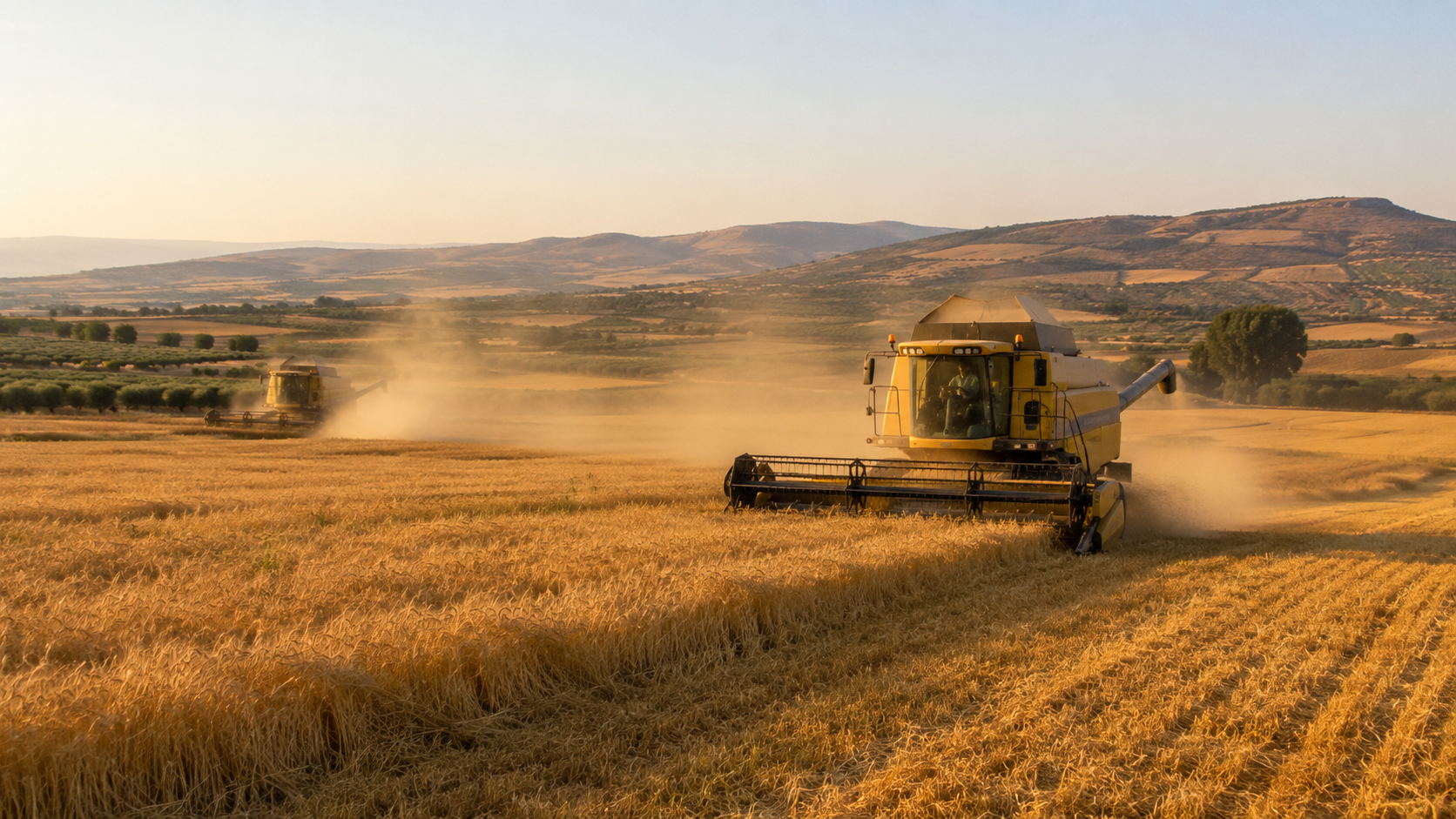
Tunisia's insurance federation has rated Jendouba and Béja as the country's highest-risk governorates for harvest fires, releasing a risk map on Sunday 28 June as combine harvesters work through a bumper cereal season that has already brought in more than 6.6 million quintals.
The Tunisian Federation of Insurance Companies (FTUSA) published the map as part of a public awareness campaign timed to coincide with the harvest season and the onset of peak summer temperatures.
The FTUSA said the classification was built on several indicators, including the density of cereal crops, proximity to forested areas, prevailing climate conditions, high temperatures, and the frequency of fires recorded in recent years.
The risk tiers
Jendouba and Béja were placed in the "very high risk" category. Le Kef, Bizerte and Siliana were classified as "high risk", a tier the FTUSA linked to the combination of active harvesting and rising temperatures.
Zaghouan, La Manouba and Kairouan were placed in the medium-risk band, while Sidi Bouzid, Kasserine and Sfax were classified as low risk. Gabès, Médenine, Tataouine, Tozeur and Kébili were rated very low risk.
The FTUSA described the map as a tool to support awareness and prevention efforts, and called on all parties, in particular farmers and landowners, to observe safety rules during the harvest period to prevent fires and reduce their impact on agricultural production and natural resources.
Why Jendouba and Béja top the list
Both governorates sit at the heart of Tunisia's grain belt. Béja led national cereal collection this season with 1.025 million quintals, accounting for 20.29 percent of the total collected. Le Kef and Kairouan followed, with Siliana, Bizerte and Jendouba each contributing between 10 and 12 percent.
The concentration of cereals and forested hillsides in the north-west creates a compounding hazard. Each summer, Tunisia faces a surge in harvest and forest fires driven by the overlap of the grain harvest and heat waves, making reinforced vigilance and rapid-response systems essential.
Fires have already broken out this season. Civil Protection teams, backed by volunteers and the Jendouba Forestry Directorate, brought an overnight fire under control in Sidi Mbarek in the Balta Bou Aouan delegation on 21 June; the blaze consumed more than one hectare of durum wheat and around three hectares of dry straw. The cause remained under investigation, though preliminary indications pointed to harvest residue ignited while a combine harvester was operating on the site.
A fire in mid-June destroyed nearly 3.5 hectares of durum wheat near Sidi Ameur, in Testour delegation, Béja, where intensive fire-prevention awareness campaigns had already been run ahead of the cereal harvest season, which started on 7 June.
Fires recorded since late May
The Civil Protection recorded 27 fires between Aïd al-Adha and Sunday 31 May 2026, destroying 52 hectares of wheat and barley crops, according to Lieutenant-Colonel Khalil Mechri, head of operations monitoring at the National Civil Protection Office.
The main causes identified were discarded cigarette butts and sparks produced by combine harvesters during harvesting operations.
As part of its protection programme for the agricultural campaign and forest heritage, Civil Protection has deployed 14 seasonal forward-response centres across several governorates, including Jendouba, Le Kef, Siliana and Béja, with a mandate to ensure rapid intervention during the high-risk harvest period.
A bumper harvest at stake
The 2025–2026 cereal campaign is shaping up as a particularly favourable one for Tunisia, with authorities forecasting a harvest exceeding 22 million quintals, above the previous season. National collection had reached 6.629 million quintals as of 26 June 2026.
The area sown reached around 971,000 hectares, some 87 percent of the planned programme, with about 834,000 hectares concentrated in the northern governorates.
Despite the strong harvest outlook, domestic production remains below national consumption, estimated at around 30 million quintals a year, with the shortfall in soft wheat covered by imports for flour and bread production.
Farmers in at-risk governorates were urged to plough field borders, maintain harvesting equipment in good working order, and avoid any open burning near standing crops or dry straw.