
Kef municipality announces stray dog shooting campaign, reigniting Tunisia’s animal welfare debate
A June campaign announced by Kef municipality has revived anger over Tunisia’s continued use of dog shooting, despite years of civil society pressure for vaccination, sterilisation and an animal welfare law.
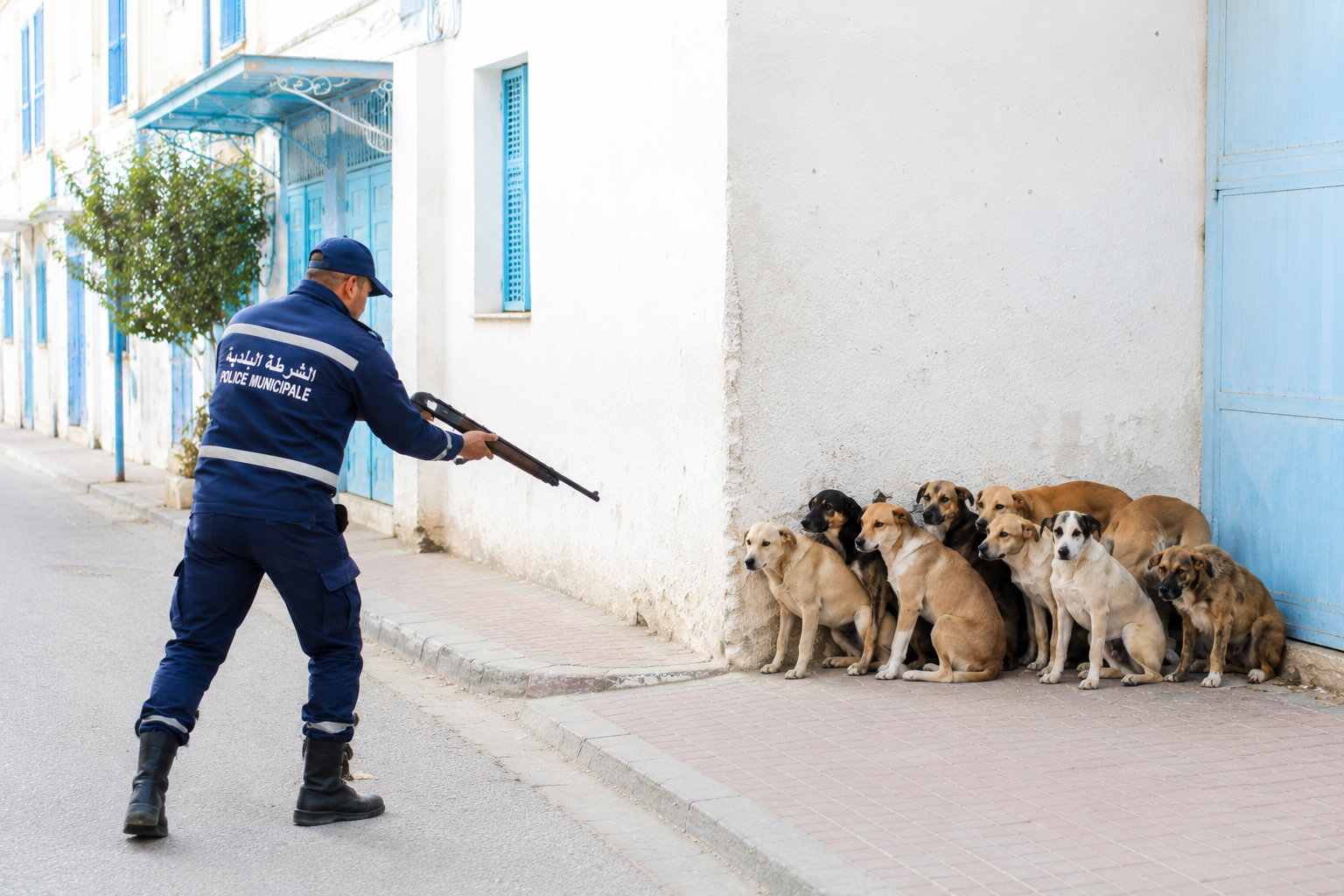
On June 5, Kef municipality announced a month long campaign to shoot stray dogs, asking residents to take precautions while the operation is carried out. The notice, reported by Mosaïque FM, quickly moved the issue beyond one governorate.
Tunisia’s stray dog problem is real. Rabies remains a public health danger. Residents report packs near schools, markets, waste areas and residential streets. Parents worry about children walking alone. Municipalities are under pressure to act.
But shooting dogs is not a policy. It is a brutal substitute for one.
Animal welfare groups have spent years calling for another approach. On May 18, the Association de Protection des Animaux de Tunisie called for a protest outside Parliament on May 23 under the slogan: “Vaccinate, sterilise, don’t kill.” The demand was direct: end the killing of stray dogs in public spaces and adopt methods based on vaccination, sterilisation and protection.
The Rahma Association for Animal Protection has also pushed the issue into Parliament. In February 2026, its representatives met Parliament Speaker Ibrahim Bouderbala and called for the examination of the animal protection draft law to be accelerated. The text had been submitted by MPs on July 23, 2024 and referred on August 1, 2024. It has not yet been adopted. The Parliament’s own website still lists proposal No. 066/2024 as being before committee, assigned to the Agriculture, Food Security, Water Security and Fisheries Committee, with the General Legislation Committee asked to give an opinion.
The draft law includes penalties for animal mistreatment and cruelty, and provides for veterinary care, disease prevention and centres for animals affected by abuse. It is supposed to mark a clear shift from nuisance control to public responsibility.
That shift has never reached the streets.
Municipalities still respond unevenly. In May, Tunis municipality defended a protocol based on collection, sterilisation, housing, care and later transfer to a facility linked to Belvédère. Elsewhere, shooting remains part of the municipal toolkit. Citizens are left with one policy in one city and another policy elsewhere.
Kef is a reminder of a wider national impasse. Tunisia already has associations pushing for reform, veterinarians warning about rabies, and a draft law that would move animal protection from moral appeal to legal obligation. What remains missing is a Parliament willing to vote the text, give it force, and turn years of advocacy into binding public policy.
The argument for shooting usually comes wrapped in urgency. It is said to be fast, necessary, practical. Yet its repetition proves its weakness. If the same campaigns return every few months, they are not solving the problem. They are only clearing the streets temporarily while reproduction, abandonment and poor waste management continue.
The Kef campaign should not pass as ordinary local news. Parliament has had an animal welfare draft law before it since 2024. It should vote on it, give it force, and remove the killing of stray dogs from the ordinary repertoire of municipal action.
Tunisia does not lack alternatives. It lacks a decision.