
Lebanon-Israel framework deal threatens to shield war crimes from justice, six rights groups warn as 646,000 displaced begin return
Six leading human rights and press freedom organisations say the US-brokered framework agreement signed in Washington on 26 June blocks victims of war crimes in Lebanon from pursuing accountability at international courts, while leaving tens of thousands unable to return to a devastated south.
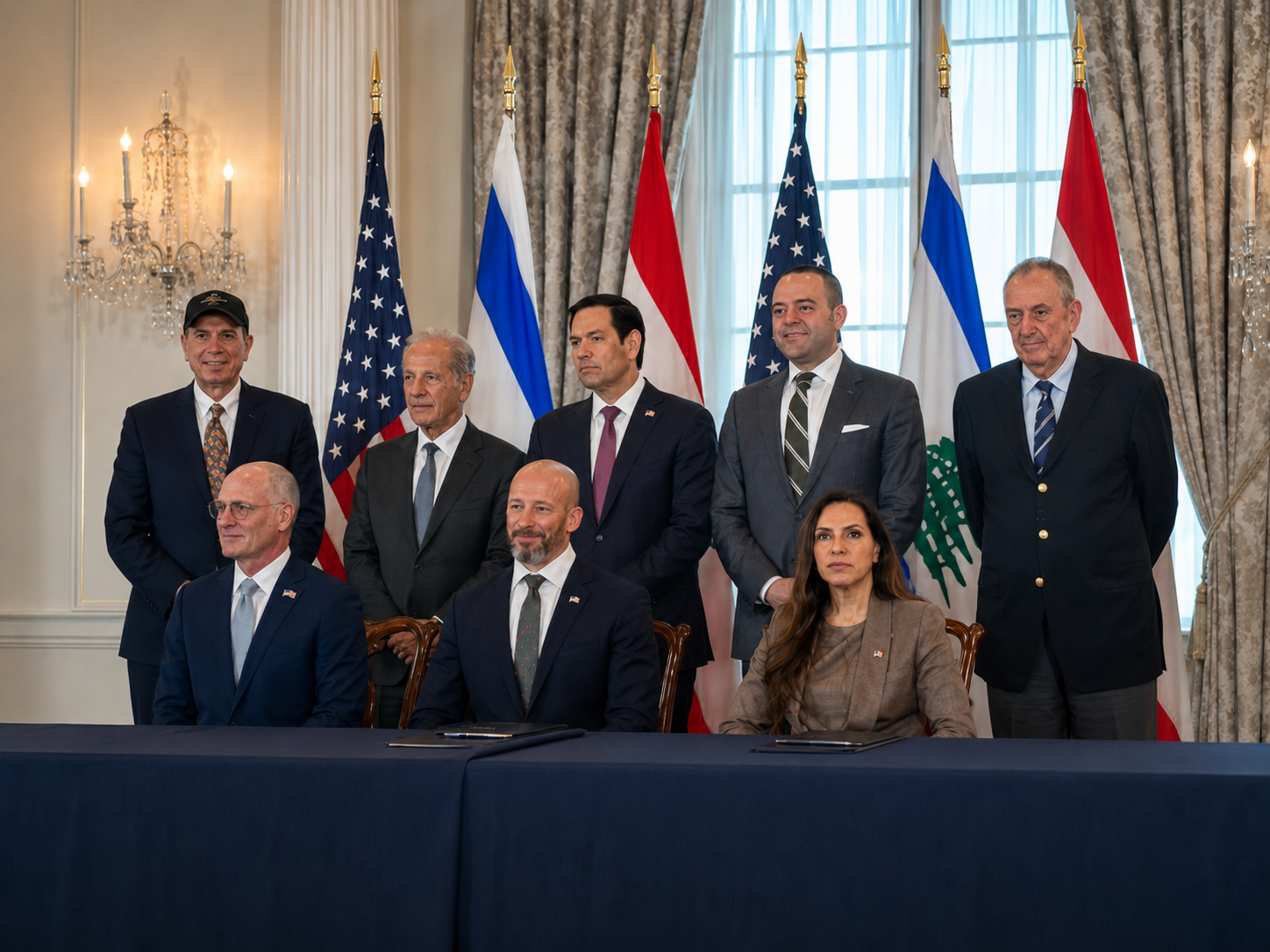
Six major human rights and press freedom organisations warned on Friday 3 July that the Israel-Lebanon framework agreement signed in Washington eight days earlier "threatens to betray the victims of war crimes" by blocking them from pursuing accountability at international courts, even as more than 646,000 displaced Lebanese began making their way home.
In a joint statement, Amnesty International, Human Rights Watch (HRW), the Lebanese Center for Human Rights (CLDH), Legal Agenda, Reporters Without Borders (RSF) and the Union of Journalists in Lebanon said parts of the agreement "appear to be aimed at preventing victims of serious international crimes from seeking justice before international forums".
The clauses under fire
The groups focused their criticism on two specific provisions of the 14-point trilateral accord, which was signed on 26 June by Israeli Ambassador Yechiel Leiter and Lebanese Ambassador Nada Hamadeh at the US State Department, with Secretary of State Marco Rubio presiding.
Clause 13 commits both governments to "the cessation of all hostile or adverse actions in international political or legal fora." The organisations said this language, if implemented as written, would prevent Lebanon and Israel from having recourse to international courts, including the International Criminal Court (ICC) and the International Court of Justice (ICJ), contradicting both countries' international legal obligations to pursue accountability for serious crimes committed on their territories.
The groups also noted that the clause does not appear to prevent Israel from continuing to pursue international actions against Hezbollah — an asymmetry they described as particularly troubling.
Clause 3 drew separate concern. The organisations said it further violates international law by conditioning the return of residents to border zones, currently occupied by Israeli forces, on "the successful disarmament of non-state armed groups and dismantlement of their infrastructure." Under international humanitarian law, they said, people must be allowed to return once hostilities have ended or the reasons for their displacement cease to exist.
"Time and time again, we have seen civilians in Lebanon pay the price for successive cycles of conflict and serious violations and crimes under international law with no accountability," said Agnès Callamard, Secretary General of Amnesty International.
Ghida Frangieh, head of litigation at Legal Agenda, said accountability and respect for international law were "not bargaining chips" and that states cannot negotiate away their obligation to investigate and prosecute serious international crimes.
Wadih Al Asmar, president of CLDH, called on Lebanon to promptly grant the ICC jurisdiction to investigate and prosecute crimes committed on Lebanese territory, warning that any delay "amounts to tolerance of impunity."
Elsy Moufarrej, president of the Union of Journalists in Lebanon, said the Lebanese government had "conceded a right that is not its right: the right of the victims to pursue and hold the perpetrators accountable."
A counter-reading
Not all analysts share the rights groups' interpretation. The Washington Institute for Near East Policy, in an assessment published this week, argued that the rights groups' reading of Clause 13 was "a skewed misreading of a commitment that benefits both sides," noting it also forestalls Lebanese concerns about Israeli actions in international forums directed at Hezbollah.
The Lebanese government has not publicly responded to the joint statement. Lebanese Prime Minister Nawaf Salam said at the time of signing that the agreement "aims to achieve Israel's withdrawal from all Lebanese territories."
646,000 returning, but many have nowhere to go
The rights groups' statement arrived as the scale of the displacement crisis came into sharper focus. The International Organisation for Migration (IOM), in its Displacement Tracking Matrix report published on 2 July, said 646,107 internally displaced persons had begun returning to their communities since 22 June, when data collection with local authorities began. Around 500,000 others remain displaced.
A ceasefire in Lebanon took effect on 21 June as part of an agreement between Tehran and Washington. Five days later, the framework accord between Israel and Lebanon was signed. Lebanese authorities have worked to remove informal tent encampments around Beirut and reduce the number of official shelters.
But the return has exposed the depth of destruction left behind. It remains impossible to return to dozens of towns and villages near the southern border, many of which have suffered massive destruction. A United Nations Development Programme assessment found that 11,095 buildings were completely destroyed in the 2026 offensive. Satellite analysis by the French publication Le Monde found that 45 percent of urban areas in southern Lebanon had been damaged or destroyed since March 2026.
Israeli occupation forces have maintained a "security zone" — designated a "Forward Defence" zone by the Israeli military — extending eight to twelve kilometres into Lebanese territory and covering around 600 square kilometres, or about 6 percent of Lebanon's land area. Israeli officials have repeatedly stated that forces will remain in the zone despite the ceasefire. The framework agreement does not mandate Israeli withdrawal from the area it occupies; it makes withdrawal contingent on the prior verified disarmament of Hezbollah, which the group has rejected outright.
The toll and the deal's background
Lebanon was drawn into the wider regional war on 2 March, when Hezbollah fired rockets at Israel. Israel responded with heavy airstrikes and a ground invasion of southern Lebanon. Lebanese authorities say Israeli attacks have killed around 4,300 people and displaced over one million since March, concentrated in southern Lebanon and Beirut's southern suburbs. HRW cited Lebanon's Health Ministry figure of more than 8,700 killed since the earlier round of fighting began in October 2023, including at least 569 children and 357 medical workers.
Amnesty International found in a separate investigation that the Israeli military forcibly displaced tens of thousands of Lebanese civilians, committing what it described as the war crime of unlawful transfer under the Fourth Geneva Convention. HRW and Amnesty have also documented Hezbollah's firing of unguided rockets at northern Israel, which they said unlawfully killed and injured civilians.
Lebanon's Finance Minister Yassine Jaber said the country had sustained at minimum $3–4bn in damages since March, on top of the estimated $7bn cost of destruction from the 2023–2024 round of fighting.
The joint statement called on the Lebanese and Israeli governments not to implement the agreement in ways that override their international legal obligations, and urged third-country governments that have previously supported accountability for crimes in Lebanon to clarify that their backing for the political settlement does not extend to provisions that foreclose justice, reparation or return of the displaced.