
Phosphate revival runs into Tunisia’s broken rail link
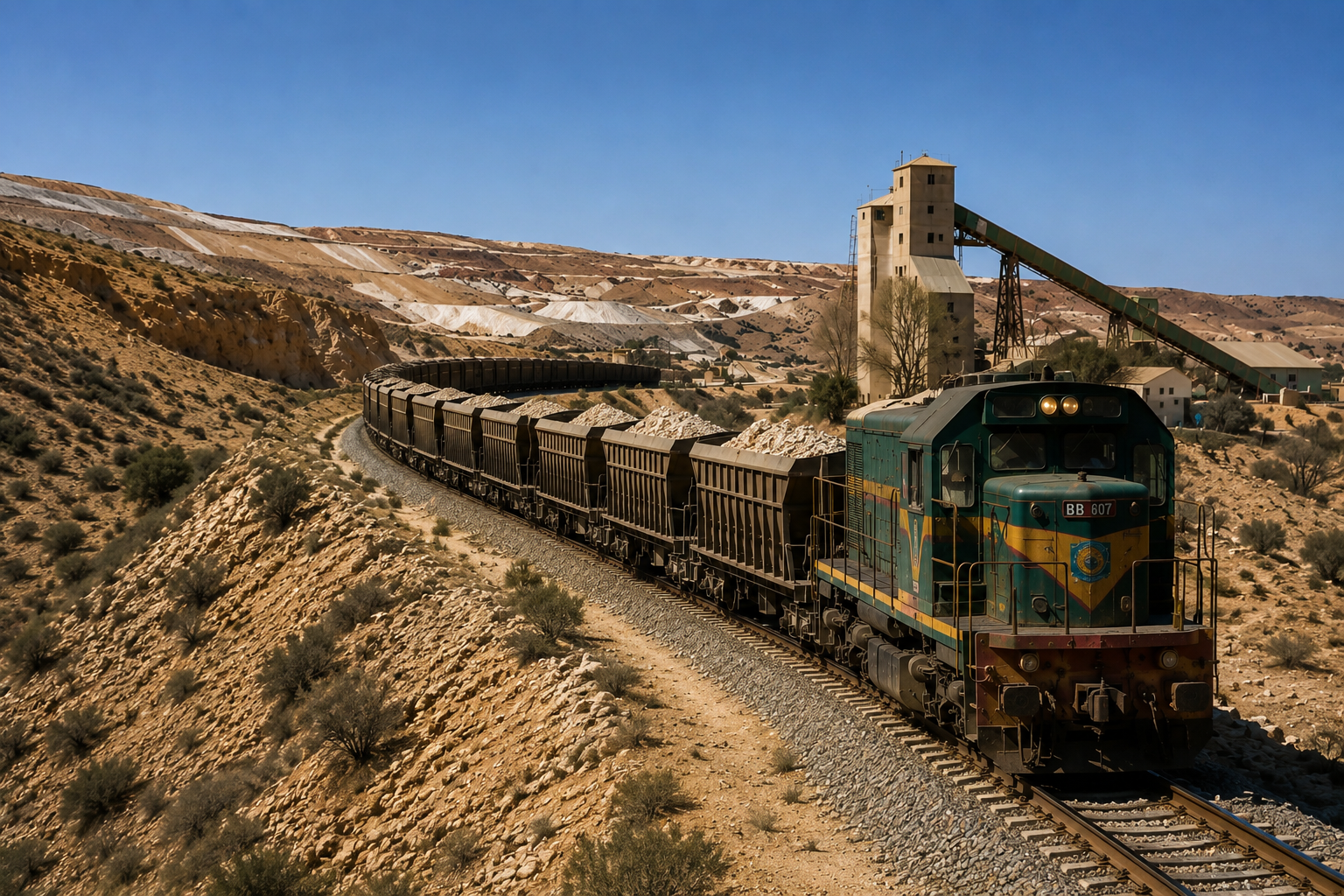
Tunisia’s plan to revive phosphate production has reached one of its oldest bottlenecks: the rail lines that move ore from the Gafsa mining basin to processing and export sites.
The Assembly of the Representatives of the People approved in April a loan agreement with the Arab Fund for Economic and Social Development to finance the rehabilitation of railway lines used for phosphate transport. The loan is worth 16 million Kuwaiti dinars, around $52 million, and is intended to support infrastructure upgrades on the national railway network.
The project targets one of the weakest links in a sector the government wants to restore after more than a decade of decline. Tunisia has set a target of raising phosphate production to 14 million tonnes a year by 2030, compared with less than 3 million tonnes in recent years and around 8.2 million tonnes before 2011.
The ambition is clear. Phosphate is one of the few sectors capable of bringing significant foreign currency into the country, supporting public finances and feeding downstream fertiliser production. But the government’s recovery plan depends on more than extraction. Ore has to move reliably from mines to processing plants and ports. That is where the railway system has become a central constraint.
The Arab Fund loan is expected to help renew and modernise rail infrastructure in the mining basin and along routes connecting Gafsa, Gabès and Sfax. Reporting on the financing says priority will be given to Line 21, the 129 kilometre stretch between Gabès and Gafsa, as well as other lines that support phosphate movement through the south.
The rail problem is not new. Years of underinvestment, ageing tracks, slow renewal of wagons and repeated disruptions have reduced the system’s ability to carry phosphate at the volumes needed for a serious recovery. Road transport has filled part of the gap, but at higher cost and with greater pressure on roads, safety and logistics.
For SNCFT, the stakes are also financial. Phosphate transport has historically been one of the railway company’s most important freight activities. When phosphate output falls or cannot move, the impact is felt not only by the Compagnie des Phosphates de Gafsa and the Tunisian Chemical Group, but also by the national railway company itself.
The rail loan follows earlier external financing for the same sector. In 2024, the Saudi Fund for Development signed a $55 million agreement to support the renewal of about 190 kilometres of railway used for phosphate transport in the south. Together, the financing points to a wider effort to repair the transport chain behind the government’s 2025 to 2030 phosphate plan.
The challenge is that rail is only one part of the sector’s problem. The phosphate industry has been weakened since 2011 by social unrest in the mining basin, production stoppages, recruitment disputes, ageing equipment, public enterprise constraints and environmental opposition in Gabès. A repaired rail line can improve transport capacity, but it cannot alone solve disputes over jobs, pollution, governance and local development.
Those tensions are already visible. In Gafsa, the sector remains tied to demands for employment and regional justice. In Gabès, where phosphate is processed into phosphoric acid and fertilisers, residents and environmental groups are demanding the dismantling of polluting industrial units. The Stop Pollution movement has called for renewed mobilisation this month, keeping pressure on the state over toxic emissions and the future of the chemical complex.
That creates a difficult contradiction for the government. It wants to increase phosphate output sharply by 2030, but the sector’s recovery runs through communities that have long felt they carried the social and environmental cost of the industry. More production may strengthen exports and public finances. It may also deepen resistance if residents see the plan as a return to extraction without reform.
The rail investment therefore matters because it shows the state is trying to rebuild the physical backbone of the sector. It also shows how much has to be repaired before the production target becomes credible. Tunisia cannot move 14 million tonnes of phosphate a year on a logistics system that has struggled to carry far lower volumes.
The next test will be implementation. The financing has been approved, but the timetable for works, procurement, wagon renewal and line rehabilitation will determine whether the project produces visible gains before the 2030 target comes into view. Delays would weaken the credibility of the entire recovery plan.
For now, the phosphate revival remains a promise built on several fragile links: mines that must produce, trains that must move, factories that must process, ports that must export, and communities that must accept the cost. The rail project addresses one of those links. Whether it is enough to restart the chain is another question.