
Screen pick- The Tunisian debut winning rooms from Sundance to Milan
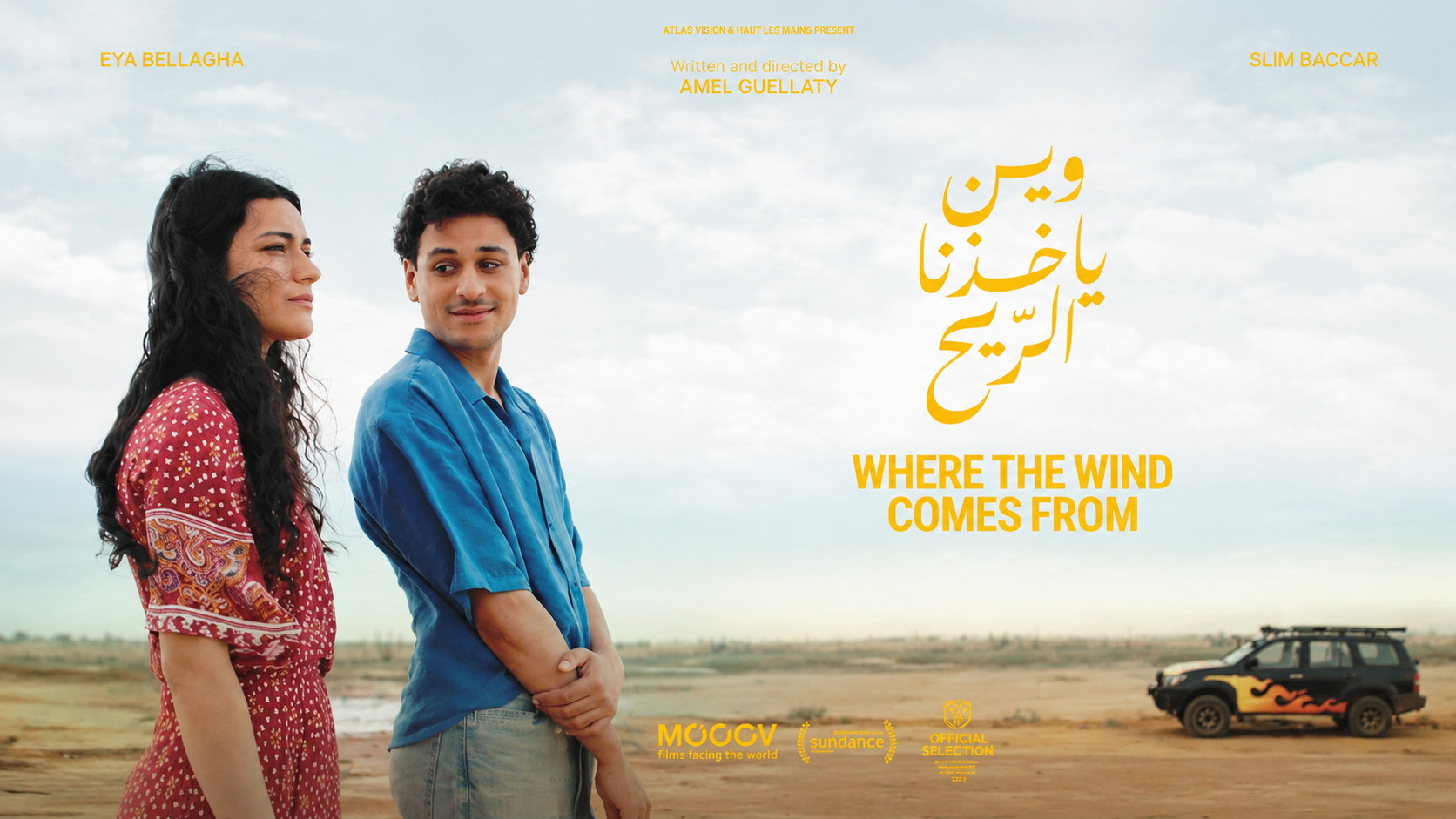
The first time you see Alyssa, she is sitting on a bridge railing with the traffic rushing beneath her, daring the world to tell her to come down. She is nineteen, she wears red in a film that paints everything around her blue, and she wants out, of her town, her constraints, the script a young woman in Tunisia is handed at birth. Her best friend Mehdi is twenty three, quiet where she is loud, an artist who pours the pressure of his surroundings into surreal drawings. When the two of them hear about an art contest in the south that could fund an escape to Europe, they steal a pickup and drive toward Djerba, and a small road trip opens into a portrait of an entire generation.
That film, Where the Wind Comes From, is the debut feature of the Tunisian writer and director Amel Guellaty, and this month it added another trophy to a run that began at Sundance. At the Milano Film Fest in June 2026 it won Best Feature from a jury chaired by Valeria Bruni Tedeschi, and took the student jury prize as well, with a citation praising a portrait of a generation that meets the contradictions of the present with courage, resilience and a poetic eye. For a first film from a director who never went to film school, the reception has been its own kind of road movie.
The journey is the point
The shape of the story is familiar, two friends, a car, a destination, the breakdowns and detours and fights that every road movie runs through. Guellaty uses the contest in Djerba as a destination that barely matters, because the film is about the getting there. Along the way Alyssa and Mehdi steal from a convenience store, lift a vehicle from a local thug, scream into an empty sky, and test a friendship built to survive almost anything. The two are kept in the same frame for most of the film, side by side, until the desert pulls them apart.
What lifts the film above its genre is its refusal to explain itself. Guellaty resists melodrama and political lecture, and lets youth appear as it actually is, impulsive, funny, contradictory, full of grace one minute and bad decisions the next. The cinematographer Frida Marzouk frames the Tunisian landscape without exoticism and without despair, the roadside margins and open horizons reading at once as a promise and a trap. The characters often sit low in the frame, as one critic noticed, as though the director were leaving the top of the shot empty to hold their dreams.
A director who arrived at cinema sideways
Guellaty did not take the usual route. She grew up in a household where art was simply the air, her father a book publisher with a passion for photography, and as a child she wrote scripts and staged plays with her cousins before she had reached double figures. She has said she had the rare luck to grow up where culture mattered and creativity was encouraged, and that directing was in her from the start, school or no school. She came to film as a photographer first, and the image remains the thing she trusts to speak for her.
Her path ran through short films that travelled widely. Black Mamba in 2017 was selected at more than sixty festivals and won around twenty awards before French and Italian broadcasters picked it up, and Chitana followed in 2021. Where the Wind Comes From she had carried for years, developing it from 2019 at the CineGouna workshop in Egypt, returning in 2023 with the film in post production, a slow build that is normal for an independent first feature from the region and invisible in the confidence of the finished work.
Red and blue, and the space left for dreams
Guellaty's instincts are those of a stylist. She dresses Alyssa in red and the world around her in blue, and keeps the friends in a single shot to insist on their bond until the moment it cracks. When Alyssa daydreams, the screen tips into animation and a classroom becomes a ballet stage, the weight of the real lifted for a few seconds at a time. The director has spoken of studying Almodóvar and Godard's Pierrot le Fou, of wanting a road movie that follows the rules of imagination rather than the handheld realism the genre usually reaches for.
The same instinct shapes how she talks about her characters' inner lives. Their dreams and projections, she has said, are what keep them alive, and imagination is the emergency exit every person carries, a way to reshape a reality that can feel unbearable. In a country where a third of young people look for a way out, that line lands as more than a directorial note.
A generation looking for the door
Under the comedy and the colour, the film is about pressure. Alyssa and Mehdi belong to the Tunisia that followed the 2011 revolution, a generation handed freedom of speech and very little economic ground to stand on, and the art contest is really a coded route to Europe. Guellaty touches migration, patriarchy and the quiet corruption of daily life with a light hand, never turning her leads into symbols. The ending refuses the easy resolution. Mehdi leaves Tunisia, chasing a dream that was never quite his, while Alyssa stays and finds herself in her father's workshop, in his art, in her responsibility to her mother and sister.
That ending is the film's sharpest argument. The boy who never asked to leave is the one who goes, and the girl who burned to escape is the one who discovers that staying can be its own act of will. For a diaspora reader who knows both sides of that departure, the inversion reads as truth rather than message.
The festivals are listening
The run speaks for itself. Where the Wind Comes From premiered in the World Cinema Dramatic Competition at Sundance in early 2025, then travelled to Rotterdam, Toronto and San Francisco. At the El Gouna Film Festival in October it won Best Arab Film, the moment Guellaty described as a homecoming, the film offered back to the region that made it without translation. The Milano win this month extends a circuit that has carried the film from Utah to Lombardy, theatres full at each stop to the director's continued surprise.
What strikes the people who programme these festivals is the same thing that strikes the audiences, a film that is recognisably Tunisian and entirely legible to a stranger. Guellaty worked with a Tunisian crew, shot on location, scored the film with indie bands from Tunis, and trusted that a film made by us and about us would carry its culture without forcing it. The bet has paid off in a language any festival jury can read.
What it means at home
Guellaty arrives at a moment when Tunisian cinema is having a genuine run, her name now spoken alongside Kaouther Ben Hania as proof that the country's directors are reaching the world stage on their own terms. Two women, two very different films, one carried by the voice of a girl in Gaza and the other by two teenagers on a road south, both insisting that stories rooted in Tunisian reality belong in the largest rooms. For the young Tunisians the film is about, and for the diaspora that recognises the ache of leaving, Where the Wind Comes From offers the rarest thing, a mirror that is also a window.
The work continues. The film is moving through cinemas and festivals across 2026, and a director who waited years to make her first feature now has the attention to make a second. Alyssa would approve of the trajectory, all forward motion, eyes on the horizon, certain that the door is somewhere ahead.