
Settlers attack Palestinian farmers and activists marching to reach their land northeast of Ramallah
Dozens of Israeli settlers assaulted Palestinians and international solidarity activists near the village of Abu Falah on Friday, using pepper spray and rocks to block a march organised to help landowners access farmland in the al-Budud area they say is under threat of seizure.
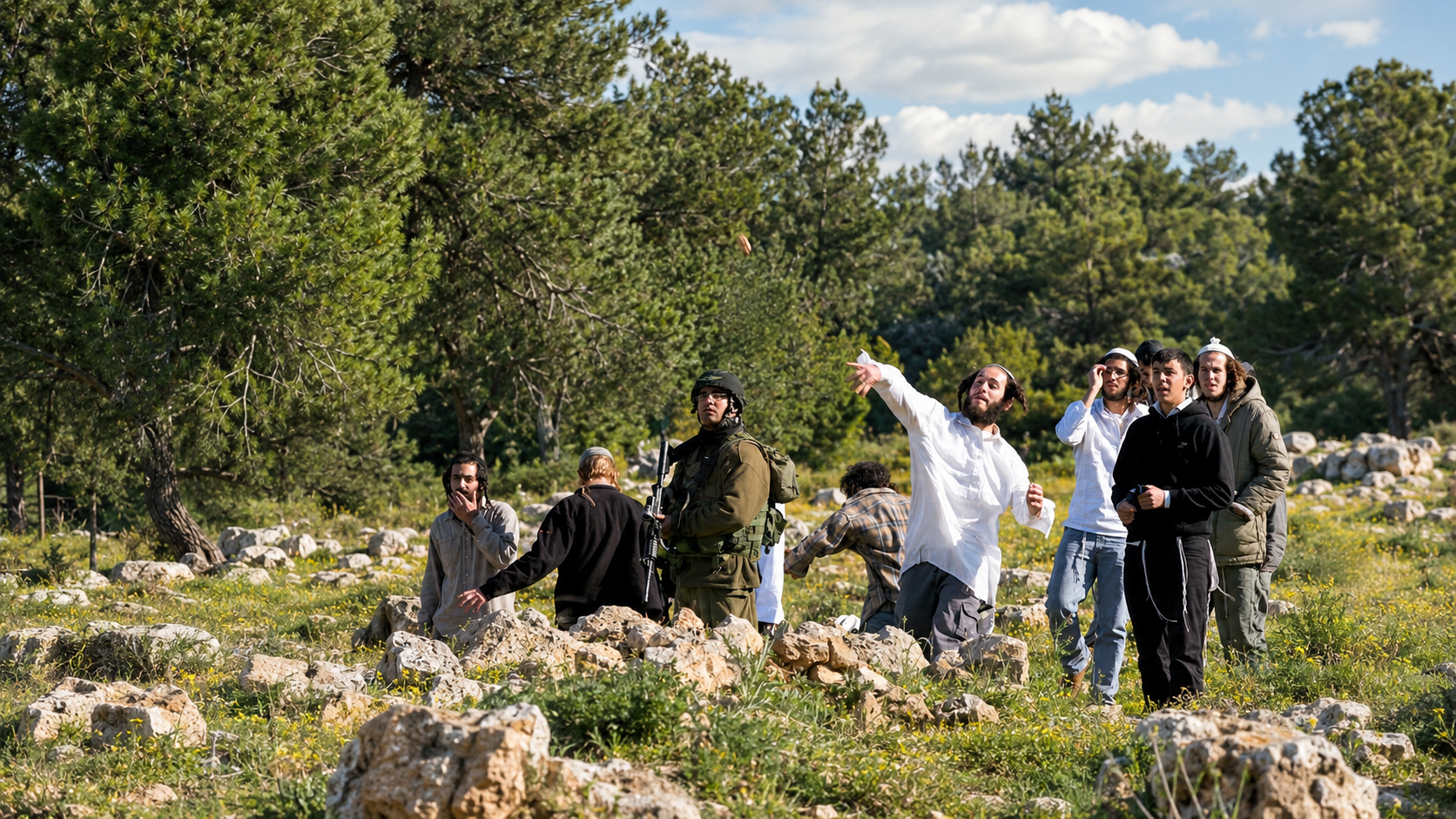
Israeli settlers attacked Palestinian residents and international solidarity activists on Friday morning on the road linking the village of Abu Falah and the town of Turmus Ayya, northeast of Ramallah in the occupied West Bank, preventing a group of landowners from reaching their farmland in the al-Budud area.
Dozens of settlers assaulted participants in the march with pepper spray and rocks, according to the Palestinian Authority's Wafa news agency. An elderly Palestinian man was injured in the attack, Wafa said. Several international activists were sprayed with pepper spray and left visibly distressed, according to footage circulated online and reported by Al Jazeera.
The march had been organised by residents of Turmus Ayya and Abu Falah to allow landowners to access farmland they say is under increasing threat of settler seizure. International solidarity activists joined the group on the road, the Palestine News Network reported.
The Israeli military had not commented on the incident at the time of publication.
A string of attacks across the West Bank
Friday's attack in the Ramallah area was one of several reported across the occupied West Bank on the same day. In the village of Beitillu, northwest of Ramallah, settlers attacked three members of the Radwan family in the Wadi al-Zarqa nature reserve, injuring all three — one with a broken arm — and stealing their mobile phones, Wafa reported. The Palestine News Network confirmed the account.
In Idhna, near Hebron in the south, settlers entered the town under the protection of Israeli soldiers and attacked Palestinian landowners, the Palestinian Red Crescent Society told Wafa. A young man was struck with a rubber-coated steel bullet; two elderly men were injured while trying to protect their sheep. Settlers also separately entered the outskirts of al-Mughayyir village, northeast of Ramallah, under Israeli forces' protection, local sources told the Palestine News Network.
Settlers also vandalised agricultural greenhouses near the Shufa military checkpoint southeast of Tulkarem, tearing nets protecting the facilities and causing damage to land belonging to the Ismail family from Shufa village, local witnesses told Wafa.
Pattern and scale
The Abu Falah and Turmus Ayya area has been repeatedly targeted. In March 2026, settlers killed two residents of Abu Falah village and a third man died after inhaling tear gas fired by Israeli soldiers during a settler attack there, according to Wafa. In April 2026, settlers launched simultaneous coordinated attacks on Abu Falah, al-Mughayyir and Turmus Ayya, burning a home and a vehicle in Turmus Ayya, Al Jazeera reported at the time.
There are an estimated 500,000 Israelis living among roughly 3 million Palestinians in the occupied West Bank, Al Jazeera reported on Friday. A United Nations inquiry published last month found that Israeli settler attacks on Palestinian villages and agricultural land had surged by 130 percent since 2023. The UN humanitarian affairs office OCHA has documented an average of six settler attacks per day causing casualties or property damage across the West Bank so far in 2026. March 2026 recorded the highest number of Palestinians injured by settler attacks in the past 20 years, UNICEF spokesperson James Elder told reporters in Geneva in May.
The UN inquiry found that Israeli forces' presence during attacks had effectively collapsed the distinction between settlers and soldiers, and that Israeli authorities were directly involved in attacks that killed, injured and displaced Palestinians, Haaretz reported in June. Israeli authorities have not publicly responded to those findings.
Palestinians and rights groups describe the pattern of settler violence, backed by Israeli state policies including settlement expansion, demolitions and restrictions on land access, as a systematic campaign of forced displacement. Israel disputes that characterisation.