
Tunisia jams signals around exam centres as baccalaureate cheating battle intensifies
Authorities deployed radio-frequency jamming around examination venues during the 2026 baccalaureate, disrupting WhatsApp and Messenger across several regions — prompting business complaints and a sharp debate over whether the tactic works at all.
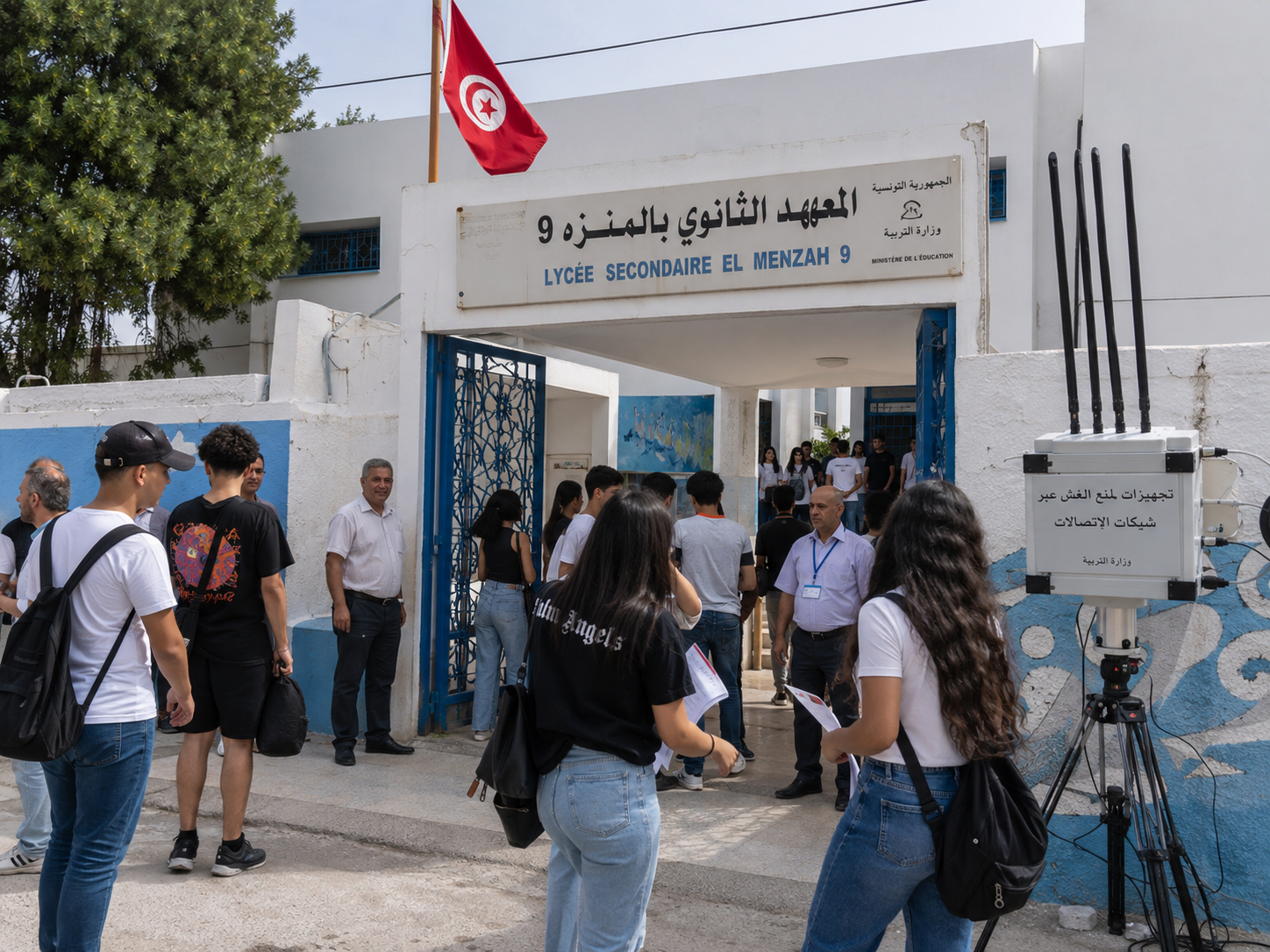
Tunisian authorities intensified signal-jamming operations around baccalaureate examination centres from the second day of the 2026 main session, causing widespread disruptions to messaging applications including WhatsApp and Messenger in several regions of the country, Tunisian media reported on Wednesday 10 June.
The written papers ran across six days — 3, 4, 5, 8, 9 and 10 June — with 162,435 candidates sitting the exam. Results are due on Tuesday 23 June, the Ministry of Education said. Around 83 percent of candidates are enrolled in public schools, 12 percent in private institutions and 5 percent sitting as independent candidates.
The jamming, applied to the immediate perimeter of exam venues, produced side-effects well beyond the centres themselves. Businesses and residents across affected areas found messaging services intermittently unavailable during exam hours, with no advance notice from authorities. Technology expert Zied Bacha, speaking on a local radio station on 6 June, said the jamming of services such as WhatsApp and Messenger did not constitute an effective anti-cheating measure, because other applications and channels remained available to determined fraudsters. He added that the disruption had caused direct harm to companies relying on those platforms for daily operations.
The Ministry of Education and government sources confirmed to Tunisian fact-checking outlet BN Check on 4 June that no decision had been taken to cut or suspend internet access nationwide. Authorities said their approach rested on reinforced surveillance and a total ban on mobile phones and electronic devices inside examination halls — applicable to candidates and unauthorised personnel alike.
Education Minister Noureddine Nouri visited two examination centres in the Ariana governorate on the morning of 4 June to monitor the second day of papers, reaffirming the ministry's commitment to ensuring equal conditions for all candidates.
Cheating ring dismantled
Security services dismantled an organised criminal network in Sousse on 2 June, one day before the written session opened. Five people were arrested, including two baccalaureate candidates. Officers seized electronic earpieces transported from the Monastir governorate. A separate network, which had been using social media pages to market cheating devices, had already been broken up in late April, according to the Interior Ministry.
Despite the enforcement drive, cheating attempts were reported from the first day of exams. The Ministry of Education warned that penalties range from immediate exclusion from the paper to a ban on sitting the baccalaureate for up to five years, with the possibility of criminal prosecution depending on the severity of the offence.
Regional pattern, Tunisian variation
Exam-related internet disruptions are a recurring feature of the broader MENA region. Iraq imposed a series of full shutdowns during its own school examinations in May and June 2026. Algeria, which has cut nationwide connectivity every baccalaureate season since 2018, limited its 2026 restrictions to within exam centres after years of criticism that full blackouts imposed disproportionate costs on the economy and violated rights to information and free expression.
In Tunisia's case, no such full shutdown was ordered. But the collateral reach of localised jamming — and the absence of any public notice — drew criticism from business operators and digital-rights observers who argue that targeted technical measures inside centres, combined with encrypted digital transmission of exam papers, would achieve better results without penalising the wider public.