
Tunisia targets Malaysia, Indonesia and Asian markets as it prepares the 2026/2027 date export campaign
Tunisia's minister of commerce announced on Friday that the country will shortly begin exporting dates to Malaysia, Indonesia and other Asian destinations, as authorities open a sector review ahead of the next campaign on the back of a record harvest of 404,000 tonnes.
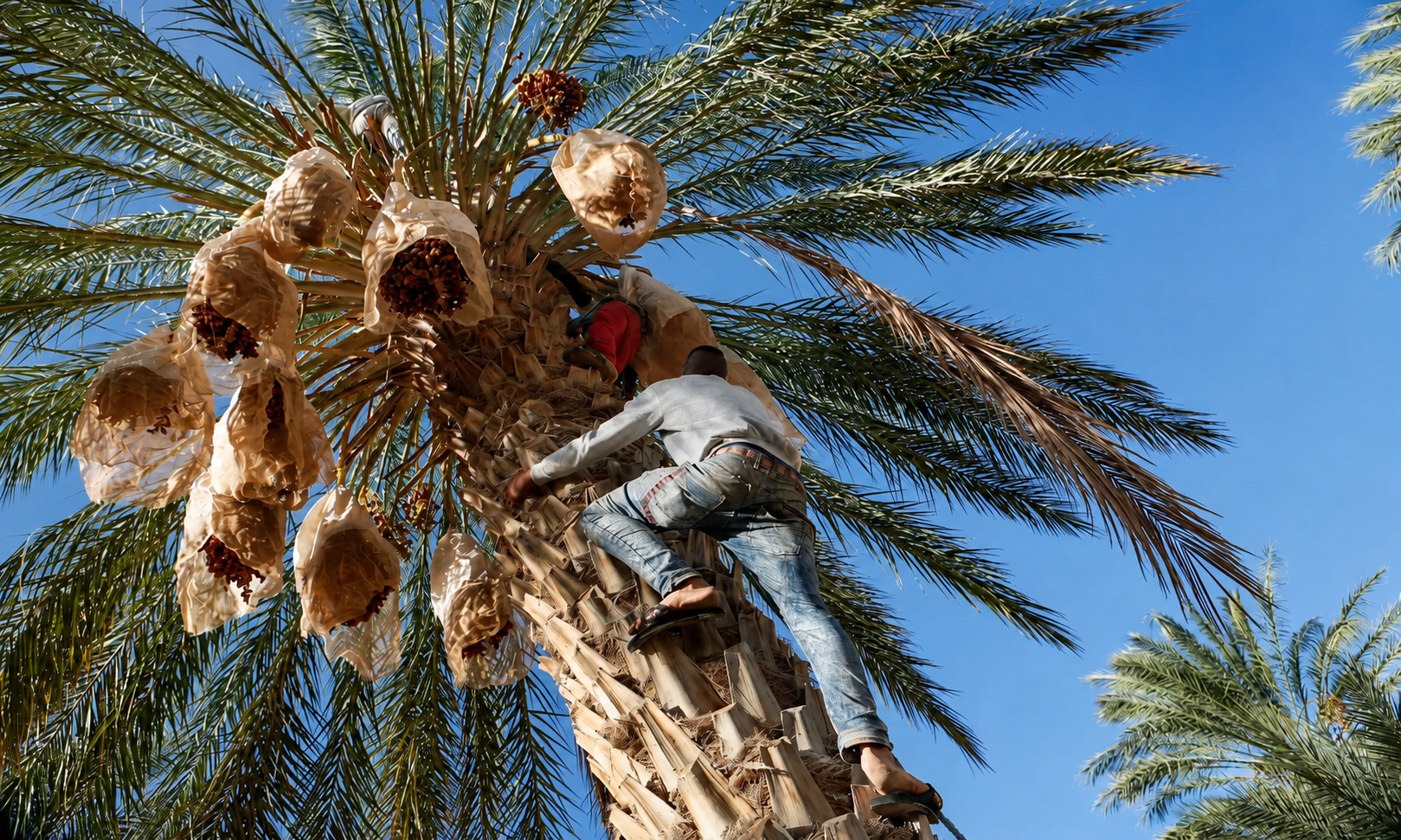
Tunisia will shortly begin exporting dates to Malaysia, Indonesia and other Asian markets, the Minister of Commerce and Export Development, Samir Abid, said on Friday 27 June 2026, as authorities launched a formal review of the outgoing campaign and began preparations for the 2026/2027 season.
Abid made the announcement during an evening coordination session dedicated to evaluating the current season's export performance and planning the next campaign. He called on farmers, producers and exporters to engage actively in the preparations, in particular on oasis maintenance, transport, storage and export operations.
A central ambition of the minister's statement was a shift away from the sector's traditionally seasonal rhythm. Tunisia should export dates continuously throughout the year, Abid said, not only during the post-harvest period.
A record harvest, but price pressure bites
The 2025/2026 season produced around 404,000 tonnes of dates — the first time output has crossed that threshold — with the Deglet Nour variety accounting for around 347,000 tonnes, according to data from the National Observatory of Agriculture (ONAGRI).
Export volumes for the first eight months of the campaign reached 121,500 tonnes, up 5.3 percent on the same period a season earlier, generating revenues of 770.7 million dinars, a rise of 4.8 percent. The gap between volume growth and revenue growth reflects a fall in average prices: ONAGRI recorded a 7 percent drop in the average export price during the eighth month of the campaign, to 5.96 dinars per kilogram.
An earlier parliamentary hearing, held by the National Council of Regions and Districts in April, had put cumulative exports at around 108,000 tonnes and revenues at around 705 million dinars to 10 April 2026 — compared with around 857 million dinars over the full 2024/2025 season, underscoring the price squeeze facing the sector despite robust volume growth.
The Deglet Nour variety accounts for around 85 percent of total export volume. Tunisia's organic date segment continues to outpace the wider sector: exports reached 7,024 tonnes in the first eight months, valued at 71.9 million dinars, up 28.4 percent by volume on the previous year, though organic dates still represent only around 5.8 percent of total shipments.
Markets: Europe dominant, Asia growing
The European Union absorbed 44.2 percent of Tunisian date exports by volume in the current campaign, followed by Africa at 23.3 percent and Asia at 22.5 percent. Morocco remained the single largest destination, taking 17.1 percent, ahead of Italy at 11.9 percent and Germany at 9.7 percent. Germany is also the principal market for organic dates, taking 35 percent of that segment.
The number of export destinations reached 94 countries in the current campaign, up from 91 the previous season.
The Export Promotion Centre (CEPEX) has a programme of more than 30 promotional actions for olive oil and dates in 2026, spanning participation in international trade fairs, exploratory missions to new markets, and direct overseas promotional campaigns. Target markets named by CEPEX earlier this year include China, Qatar, Saudi Arabia, Nigeria and the United Kingdom, alongside the new Asian destinations flagged by the minister on Friday.
Sector constraints and preparations
The outgoing season surfaced persistent structural difficulties. Operators cited transport and storage problems in the early weeks of the campaign, linked in part to administrative procedures, as well as a fall in commercial prices judged out of step with product quality. The non-compliance of some operators with reference prices was also raised at the parliamentary hearing.
To address these for the coming season, authorities are organising awareness sessions for farmers, carrying out oasis maintenance work and monitoring pollination campaigns. Efforts are also under way to secure inputs, including stocks of liquid sulphur and additional mosquito net supplies used to protect date clusters.
The date sector spans around 60,800 hectares of palm groves, concentrated in the governorates of Kébili, Tozeur, Gafsa and Gabès. Over the past decade, annual production has averaged around 319,000 tonnes, dominated by the Deglet Nour variety.