
Tunisia’s champions keep winning. Many say the system is failing them.
Amen Allah Tissaoui’s dispute with the para-sports federation has reopened a wider question in Tunisian sport: why do medal-winning athletes so often end up fighting over contracts, funding, preparation and basic support?
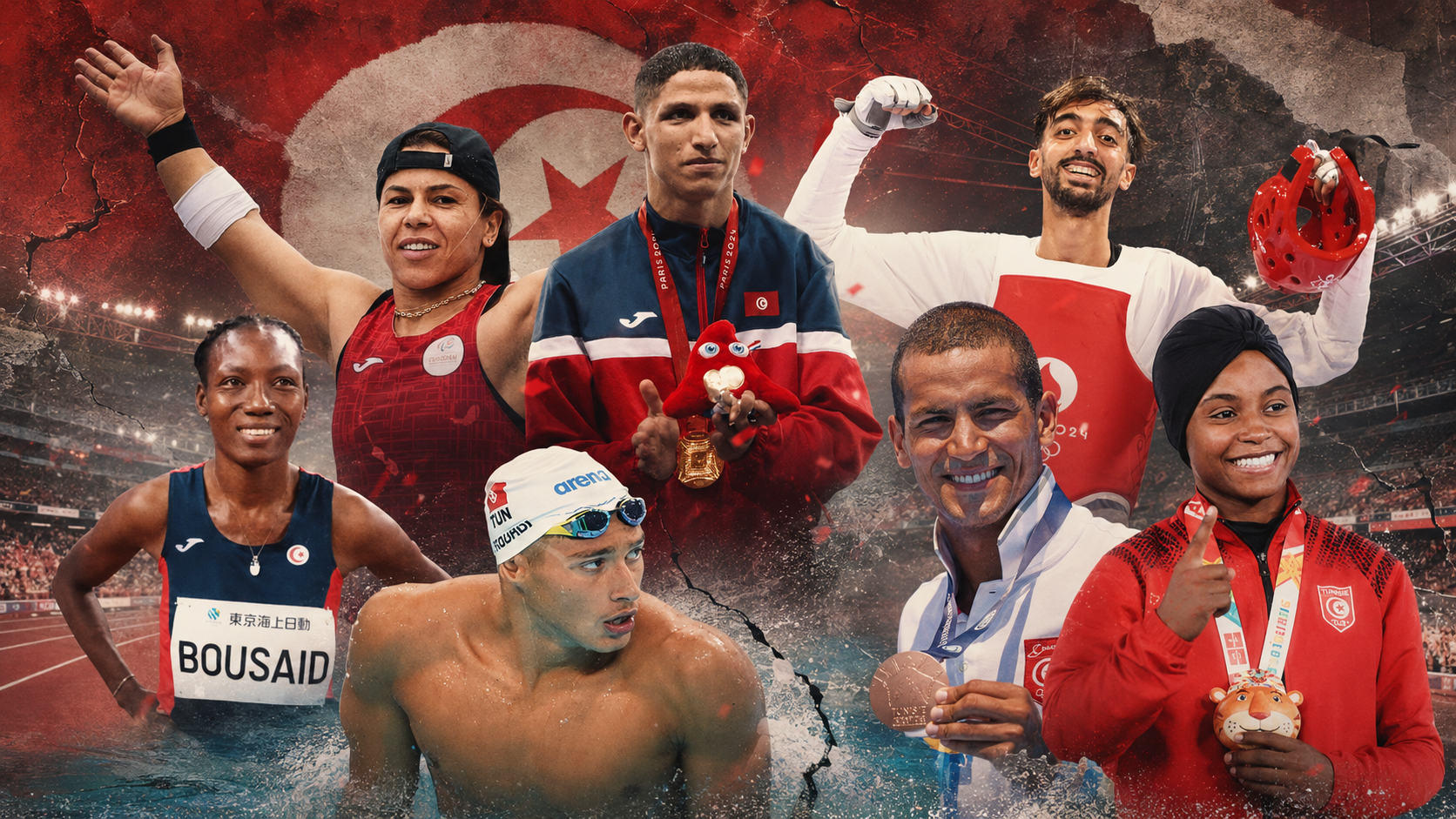
Amen Allah Tissaoui had just delivered another world-class performance when his season began to fall apart.
On 22 June, competing in the United States, the Tunisian Paralympic athlete broke the 1500m world record in his class for the third time this season, running 3:49.89. Within days, he announced the premature end of his season with a tibial stress injury, forcing him into rest, a halt to training and weeks in a medical boot.
Between those two moments came a public dispute that has put Tunisia’s treatment of elite athletes back under scrutiny.
Tissaoui said he had been left without proper support during his training camp abroad. He said he had gone months without financial backing and that his American coach, Scott Simmons, had been covering much of the cost of his preparation, including travel, food, equipment, competition entries and medical care.
The Tunisian Federation for Para Sports rejected the suggestion that it had abandoned him. It said his preparation camp in the United States was covered by an objectives contract, including coaching, accommodation and logistical expenses. It said the delay was linked to international transfer procedures and that it had contacted the Central Bank of Tunisia to speed up payment.
The federation also cited an invoice from Simmons for $13,970, covering the period from 8 March to 12 July 2026, at $110 a day.
Tissaoui contested the federation’s version. He said no agreement required his coach to cover his living costs while waiting for money to arrive, and that Simmons’ role was to supervise his sporting preparation.
The facts of the case are disputed. The wider issue is harder to dismiss.
Tissaoui is not a fringe athlete. He won Paralympic gold in the 1500m T38 event at Paris 2024 and bronze in the 400m T37. He is one of the athletes who helped sustain Tunisia’s reputation as a leading Arab and African para-sport nation.
When an athlete with that record says he has been left exposed during an overseas training camp, the question moves beyond one federation file. It becomes a test of how Tunisia manages the people it celebrates.
A familiar complaint from para-athletes
Tissaoui’s case follows other public complaints from Tunisian para-athletes.
In March, Raoua Tlili, one of Tunisia’s most decorated athletes, posted a video in which she criticised the condition of elite athletes in individual sports. She said she had worked through 2025 without pay and without a properly signed contract, and that 2026 was unfolding in the same way.
Tlili said she had personally paid costs linked to a recent international competition in India, where she won a bronze medal. She also said her training programme had been reduced, despite being designed with budget constraints in mind, and that a coach approved for her London-based preparation had gone unpaid.
Her words carried weight because of her record. Tlili is one of Tunisia’s greatest Paralympians. She has won multiple Paralympic titles in shot put and discus, including two gold medals at Paris 2024.
Somaya Bousaid raised similar concerns years earlier. In 2019, she appealed for help to take part in the World Para Athletics Championships in Dubai, saying a conflict with the handisport federation had blocked the signing of an objectives contract already approved by the Ministry of Youth and Sports.
In 2021, Bousaid said the Tunisian Federation of Sports for the Disabled had frozen her rights after she spoke publicly about alleged corruption and injustice. She said she had grants and rights recognised by the Ministry of Youth and Sports and had taken legal steps to pursue her case.
The details differ from one athlete to another. Each federation response has to be treated separately. But the pattern is visible: decorated athletes, public appeals, disputed contracts, delayed money and unclear responsibility between ministry, federation, coach and athlete.
The problem goes beyond para-sport
The same questions appear in other disciplines.
In January, taekwondo champion Mohamed Khalil Jendoubi criticised what he described as neglect by the Ministry of Youth and Sports after his world title. He said his education file had not been handled properly while he was away for a training camp and world championship, leading to his exclusion from his institute.
Jendoubi also said he was receiving a monthly grant of 900 dinars, but had not received it for six months.
His case carried particular force because of his status. Jendoubi won Olympic silver at Tokyo 2020 and has since remained one of Tunisia’s strongest medal prospects in combat sport.
Swimming has produced similar disputes.
Ahmed Jaouadi, world champion in the 800m freestyle, said in November 2025 that he had repeatedly tried to contact officials to regularise his administrative situation, but had received no clear answer. He said his contract had been ready since February and remained unsigned. He also said he had already spent €80,000 of his own money.
A senior ministry official disputed his version, saying negotiations had started in May and that funds for his coach had been sent to the Tunisian Swimming Federation.
The federation and Jaouadi’s team later disputed the figures. His team said the sums received covered only part of his annual preparation costs, including housing, food, training camps, international competitions and travel.
The argument was technical. The image it created was simpler: a world champion, after one of the greatest Tunisian swimming performances in years, sitting in public discussion over unpaid costs and disputed transfers.
The warning signs were there years ago
The dispute between athletes and institutions is not new.
In 2017, fencer Azza Besbes, a world silver medallist and one of Tunisia’s leading individual athletes, complained of a lack of material support from the fencing federation and the Ministry of Youth and Sports.
Besbes said the lack of preparation had kept her away from several World Cup tournaments. She also criticised late or insufficient bonuses and said the support available did not allow her to compete regularly or rely on her coach from the start of preparation.
The fencing federation said it was working within the budget available and doing what it could to support athletes. The following year, the Ministry of Youth and Sports said Besbes had received 308,000 dinars in payments and advances, and called on her to coordinate with her federation to sign her contract.
That exchange has become a familiar script in Tunisian sport. Athletes describe delays, weak preparation and poor communication. Institutions respond with figures, procedures and contract language.
The gap between the two is where careers are strained.
Oussama Mellouli’s final Olympic cycle showed another version of the same problem. In 2021, the double Olympic swimming champion briefly withdrew from the Tokyo Games after a long dispute with the Tunisian Swimming Federation, then reversed his decision after intervention from the Tunisian Olympic Committee.
For a swimmer preparing for a sixth Olympic appearance, the dispute became part of the story. It should have been only about the race.
Some athletes choose to leave
The pressure is not always expressed through interviews or public statements. Sometimes it appears through departure.
In October 2025, weightlifter Ghofrane Belkhir left the Tunisian delegation in Norway during travel to the World Weightlifting Championships. Tunisian media reported that she later announced in a video that she was heading to Germany.
Her case has its own circumstances. The federation described her departure as irregular, and officials criticised her decision. Still, it became another sign of the strained relationship between athletes and the system around them.
Paris 2024 exposed the depth of the issue
Tunisia’s Paris 2024 Olympic delegation was its smallest in two decades, with 26 athletes compared with 63 at Tokyo 2020.
Tunisian Olympic chief Mehrez Boussiane linked the smaller delegation to financial difficulties and tougher qualification routes. He said economic pressures had affected federation programmes and limited their ability to provide high-quality preparation and infrastructure.
That explanation is important because it moves the debate beyond individual scandals.
Modern elite sport is expensive. Qualification requires international competition schedules, specialist coaching, medical support, nutrition, recovery, visas, insurance and constant administrative compliance.
Tunisia can still produce exceptional athletes. It has done so in swimming, taekwondo, athletics, fencing, tennis, weightlifting and para-sport. The weakness lies in turning individual brilliance into a stable system.
Without that system, success becomes episodic. A champion breaks through, wins a medal, receives national praise, then returns to the same struggle over money, contracts and preparation.
The missing chain of responsibility
The recurring question is simple: who is responsible when support fails?
Federations often say files are being processed, payments are delayed, procedures are being followed or athletes have misunderstood contracts. Athletes often say those explanations do not match the reality of training, travel, food, housing, medical care and competition abroad.
A programme can exist on paper and still fail in practice.
For elite athletes, timing is part of performance. A transfer that arrives late can disrupt a camp. A visa problem can damage preparation. An unsigned contract can leave an athlete unsure who pays the coach. An unpaid grant can become a daily problem.
Objectives contracts should be clear before an athlete travels. Payment schedules should match training schedules. Responsibilities should be defined in writing between the ministry, federation, coach and athlete.
That is the minimum a serious sports system owes its champions.
Medals are not a sports policy
Tunisia is good at celebrating medals. It is weaker at building the machinery that produces them consistently.
That machinery is not glamorous. It is made of contracts, logistics, nutrition, medical care, anti-doping compliance, travel support, mental health services, equipment, transparent payments and professional communication.
Those details decide careers.
Tissaoui’s case may end with a payment, a clarification or a reconciliation. That would solve the immediate dispute. It would not answer the wider question.
Why do so many Tunisian champions have to go public before their problems are heard?
The country has athletes capable of winning at the highest level. The question is whether the system around them is strong enough to keep them there.