
Where to find real couscous in Tunis
Couscous is everywhere in Tunisia and strangely easy to get wrong in the capital. The best versions are cooked for lunch, tied to a region, or served only on certain days. Here is where to find the real thing.
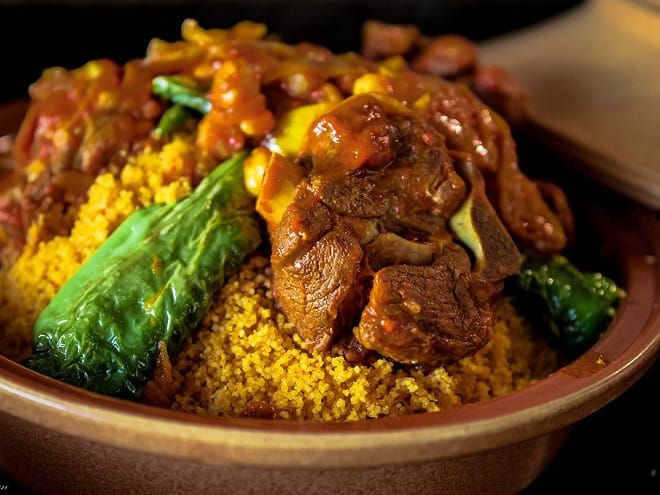
Couscous is one of the first dishes a newcomer looks for in Tunis, and one of the easiest to misjudge. Traditional restaurants can almost always put a plate in front of you. The real question is whether it was cooked with purpose or served as a tourist menu obligation.
Good couscous earns its name in the details. The grain should be steamed rather than soaked, the sauce should carry real depth, the vegetables should belong to the dish, and the protein, whether fish, lamb, octopus, osban or kadid, should tell you something about the cook, the region and the day. In many Tunisian homes couscous is still a Friday lunch, so in a restaurant the better opening line is often not "do you have couscous" but "what couscous are you making today".
Start here
- A first couscous in the Medina: El Ali
- A serious cooked lunch: Dar Slah
- A heritage courtyard setting: Fondouk El Attarine
- A formal old Tunis meal: Dar El Jeld
- Choice and daily specials: L'Arbre à Couscous, La Marsa
- Djerbian and southern cooking: El Houch, La Goulette
In the Medina
El Ali is the easiest place to send someone who has just arrived and wants the setting to match the food. It sits on Rue Jamaâ Zitouna in the heart of the Medina, two floors of pretty rooms opening onto a charming roof terrace, and it gives a graceful introduction to Tunisian cooking while the old city does the rest. It is the sensible first choice, a lunch that can drift into coffee and patisseries on the roof. Order: a first proper Medina couscous. Where: Rue Jamaâ Zitouna. Tip: ask if couscous is on the day's menu, and book for lunch.
Dar Slah is the better answer when the plate is the priority. It sits on Rue de la Kasbah, around 150 metres from the Zitouna Mosque, and comes from the family behind Chez Slah, one of the pillars of old Tunis dining. Couscous is one part of a wider repertoire here, which is why the lamb and octopus versions are worth ordering as tests. Lamb wants a sauce with depth and meat given time, octopus wants tenderness and proper seasoning, and both expose a lazy kitchen at once. Order: lamb or octopus couscous, or the day's dish. Where: Rue de la Kasbah, Medina. Tip: lunch runs roughly Monday to Saturday, midday to 3.30pm.
Fondouk El Attarine earns its place on setting as much as cooking. It occupies a former caravanserai in Souk El Attarine, a covered courtyard of columns and arches where the building does part of the work before the food arrives. The dish to watch for is fish couscous, which should taste of the sea and the sauce rather than generic tomato and chilli. Order: fish couscous, lamb, or osban if it is on. Where: Souk El Attarine, Medina. Tip: go at lunch, and note it closes Sundays.
Dar El Jeld is the formal choice, a restored fifteenth century mansion where the meal is also about the house, the service and the old Tunis atmosphere, often with live music in the evening. It suits an occasion more than a quick plate, so for couscous specifically it is worth calling ahead, since a kitchen of this kind rotates its dishes. Order: a formal Tunisian meal, couscous included by arrangement. Where: the Medina. Tip: ask whether couscous is being served that day.
Beyond the Medina
L'Arbre à Couscous answers a different need entirely, which is choice. It is a couscous bar in La Marsa built around the dish itself, with several grains, a range of vegetables, meatballs and vegetarian options, and a rotation of daily specials that runs through couscous complet, fish, octopus and boutargue. This is the place to understand how many directions couscous can take without waiting for Friday at a family table, and the plat du jour is often the one to order. Order: couscous complet, fish or octopus couscous, the daily special. Where: La Marsa. Tip: check the day's post or call ahead.
El Houch, also listed as The House, brings the south to the capital. It is one of the names to know for Djerbian cooking around Tunis, in La Goulette, and that matters because Djerbian food moves to a different rhythm, with octopus, seafood, rice, bulgur and stronger southern spicing that is harder to find inside the Medina circuit. Go for the regional plates rather than a fixed couscous every day. Order: Djerbian couscous, octopus, whatever is fresh. Where: La Goulette. Tip: call and ask what couscous is on.
What to order
The word couscous is too broad to be useful on its own, so it helps to know the versions.
Lamb couscous is the classic safe order, with tender meat and a sauce that carries real depth. Fish couscous is one of the great Tunisian versions, sharp, marine and well balanced. Octopus couscous rewards a kitchen you trust, the octopus tender and never rubbery. Osban couscous is richer and more divisive, built on spiced stuffed offal, clean and deep when it is good and unforgiving when it is not. Kadid couscous uses dried preserved meat, intense and rustic, closer to home cooking than to a standard menu. And mesfouf is a different mood altogether, lighter and sometimes sweet or seasonal, a reminder that couscous reaches well beyond red sauce.
One rule that always works
The good plates are usually cooked for lunch, tied to a region, or served on a set day. So the question that finds the best couscous in Tunis is rarely whether a restaurant has it. It is what they are making today.